
Company Registration Payment Deducted but MCA Status Shows Unpaid: What to Do
23 Nov 2026 - Licenses
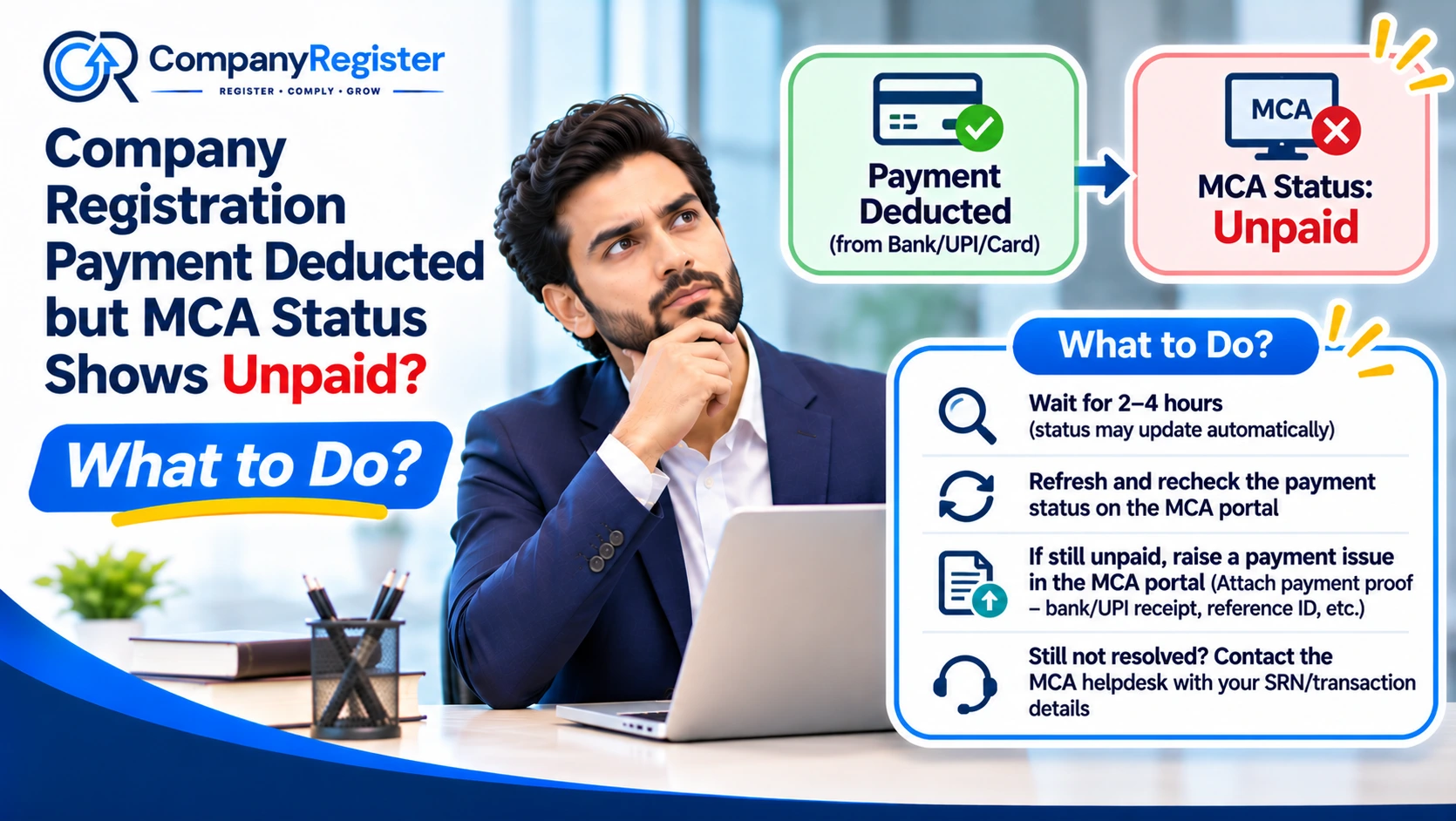
If your MCA payment was deducted but the filing still shows unpaid, first match the bank transaction to the incorporation filing’s Service Request Number (SRN). Check whether the debit is pending, settled or reversed, and raise a payment grievance through the MCA portal if the records remain inconsistent. Avoid making another payment until you understand what happened to the first one.
A bank debit, an MCA payment confirmation and a certificate of incorporation are three different things. This guide helps you trace the first payment, decide whether a fresh attempt is appropriate and keep the evidence needed if more than one debit occurs.
1. MCA payment deducted but status unpaid: which situation applies?
This recovery path is for a founder or authorised filing representative who has attempted to pay for a company incorporation filing on MCA21 and can see a debit or payment attempt, while the related filing still appears unpaid or pending. It is also useful when the payment page closes before it displays a clear result.
The payment relates to an incorporation filing, such as SPICe+ (Simplified Proforma for Incorporating Company Electronically Plus), rather than an unrelated MCA service.
You can identify the filing or the account used to make it, even if the SRN is not immediately available.
The person investigating has access to the payment record or can obtain it from the account holder.
If a professional submitted the application, you can coordinate with that person rather than starting a separate application in parallel.
1.1 Read the status as an observation
An MCA SRN payment status marked unpaid tells you what the portal currently displays for that filing. It does not, by itself, establish whether the bank has finally transferred the money, whether a reversal is on its way or whether a payment needs to be matched to the filing.
Similarly, an MCA V3 payment pending message is not a rejection of your company application. A technical or payment-stage issue and a substantive objection to incorporation are different problems, and each needs its own response.
If the MCA record already shows payment received but the application remains under review, the payment issue may be resolved even though the company is not yet incorporated. Keep the filing reference and follow the application’s later status instead of treating every pending message as a payment failure.
Where you cannot identify any filing at all, do not assume a new application is the solution. The immediate question is whether an incorporation request exists under the account used for submission; an independent second filing can make it harder to establish which request the payment concerns.
2. Prepare the evidence before raising a payment issue
For a payment investigation, you generally need transaction evidence rather than a fresh set of incorporation attachments. The exact information requested can depend on the issue and the support channel, but the following records make the case easier to trace.
Record | Purpose and useful format |
|---|---|
SRN and filing details | Identifies the MCA request. Keep the SRN as text and record the form or service name and the account used to submit it. |
Bank transaction record | Shows the amount, date, debit status and bank transaction reference. A downloadable statement entry or a clear screenshot can provide these details. |
Gateway or payment reference | Helps distinguish the payment attempt from the filing itself. Save any reference shown on the payment screen or in the bank’s transaction details. |
MCA status screen | Shows what the portal displayed for the relevant request and when you observed it. A screenshot should include the status and identifying details where visible. |
Challan or payment acknowledgement, if available | Provides another record connecting the filing and payment. Save the document or a screenshot; do not create a substitute if none is available. |
Correspondence and grievance reference | Preserves prior responses and makes follow-up easier. Retain the ticket number, messages and dates in one place. |
2.1 Understand the identifiers
The SRN identifies an MCA service request; it is not necessarily the same as the bank’s transaction reference. A gateway reference, if one is displayed, is another identifier. Record each under its own label so support staff can see which number belongs to which system.
If an MCA challan is not generated or you cannot find it, preserve the evidence you do have. A missing document does not give you a reliable basis to declare the debit failed or successful. Describe the missing acknowledgement in your enquiry and provide the other references.
Where a representative made the filing and a founder paid from a personal account, the two people may each hold part of the record. Bring those details together before opening multiple enquiries. Share only the information needed for the case; never send an account password, card security code or one-time password.
3. How to trace and resolve the payment
The aim is to establish whether one identifiable payment has been credited to one identifiable filing. Work from the original request rather than creating a new incorporation application while the first transaction remains unexplained.
Open the official Ministry of Corporate Affairs portal, MCA21, at mca.gov.in.
Use the account associated with the incorporation filing or coordinate with the person who submitted it. Locate the relevant SPICe+ request and its SRN, if available.
Use the portal’s available filing or SRN status facility to inspect the request.
Record the exact payment and filing status shown, rather than relying on a browser message from the earlier payment attempt.
Review the bank or payment-provider record for that attempt.
Establish whether it is shown as pending, completed or reversed, and note the reference and amount. If the description is unclear, ask the bank or payment provider what its status means.
Compare the filing and transaction details.
Where the debit remains recorded and the MCA request still shows unpaid, use the grievance or helpdesk option available on MCA21 to report the discrepancy. Supply the identifiers, evidence and a concise description of what you need investigated.
Keep the grievance reference and monitor the bank and MCA records.
Respond to a request for further information on the existing case where possible. If the bank confirms a reversal, or MCA support explains how to proceed, use that outcome to decide the next payment action.
Once the payment position is clear, follow the action available for the original filing.
If another payment is needed, make a deliberate attempt against the correct request and retain its separate transaction reference.
3.1 What to say in the grievance
Write the case as a sequence of observable events: the incorporation service used, the SRN if known, the amount and date of the attempt, the bank’s current transaction status and the MCA status you see. Ask for the payment to be traced against the identified request or for instructions on the appropriate next action.
If the payment page stopped responding before an SRN appeared, say so. Give the filing account and other available details rather than inventing an SRN or substituting a bank reference for it. The support team may need additional information to locate the request.
Keep the bank enquiry separate but consistent. Ask the bank or payment provider whether the debit is final, pending or reversed, and whether it can provide a traceable transaction reference. A bank can explain its own record; it cannot by itself establish that MCA has marked a filing as paid.
When the payer and filer are different people, agree who owns the follow-up. The filer can report the portal status, while the payer obtains bank details. Having one person maintain the case history reduces the chance of conflicting instructions or another payment being made without the other person’s knowledge.
3.2 Decide on a retry
A reversal changes the decision: money returned to the account is different from a debit that remains settled. If the original request still requires payment and the earlier debit has been reversed, a fresh payment against that request may be the route forward, subject to the portal’s available action and any support response.
If the debit remains settled but the portal is unpaid, seek a trace or clear guidance before paying again. An urgent commercial deadline can make a second payment tempting, but it can also leave two transactions to untangle. If a second attempt becomes necessary, record the reason and retain both payment references.
4. How long can reconciliation and incorporation take?
There is no supported universal benchmark in the material available for how quickly every bank debit will be matched to an MCA filing. A payment can remain uncertain while the bank, payment provider or MCA examines its own record. A displayed pending status should therefore be treated as a milestone to monitor, not a promise that the problem will clear within a fixed number of hours.
4.1 Separate the milestones
The first milestone is the bank’s treatment of the attempted payment: pending, completed or reversed. The second is the MCA record for the filing. The third is review of the incorporation application. These milestones can move at different speeds, and a result at one stage does not establish the result at the next.
A grievance introduces another interval: the time needed to locate the transaction and respond. Its length can vary with the completeness of the references, the payment channel, the availability of records and whether more than one organisation must investigate. A response requesting information is a reason to update the case, not evidence that the incorporation has been approved.
For planning, record when you last checked each system and when you received each response. If a business commitment depends on incorporation, allow room for both payment resolution and the application review that follows. No particular incorporation completion date can be inferred from the date of a debit.
4.2 Watch for a filing-specific deadline
If the portal or a communication concerning your particular request displays an expiry date or a deadline, record the exact wording and bring it into the support enquiry. Ask how the unresolved payment affects that request. Do not assume that a general estimate found online overrides the date shown for your own filing.
5. Fees, a second payment and possible refunds
The amount you see debited may contain more than one government charge, while a service provider’s invoice may contain other costs. The applicable government fee and stamp-duty components depend on the filing and circumstances; the MCA fee information and the amount shown for the actual request are the relevant starting points.
Cost or movement | How to assess it |
|---|---|
Government filing fee | Identify the fee shown for the incorporation request and its applicable filing details. Do not assume every company pays an identical amount. |
Stamp duty, where applicable | Look at the amount applicable to the filing and relevant jurisdiction. It is a separate component from a professional’s service charge. |
Professional or platform fee | Review the engagement terms and invoice to see what preparation, filing and follow-up work is included. This is not the MCA government fee. |
Payment-provider charges, if any | Compare the payment screen and bank record for any separately identified charge. Do not assume a charge was imposed simply because the totals differ. |
Second debit or reversal | Treat each transaction as a separate movement. A reversal reduces what remains debited; a second successful debit may require a separate recovery enquiry. |
To calculate the amount still at issue, start with the relevant debits and subtract any confirmed reversals or repayments. Then compare that net amount with the amount that should have been paid for the identified filing. This is a reconciliation method, not a determination that the difference is automatically refundable.
5.1 Distinguish a reversal from an MCA refund
A bank or payment-provider reversal returns a transaction through the payment route. An MCA double payment refund question arises when money has been paid and a separate recovery may be needed. The available remedy depends on what happened to each transaction, the nature of the charge and the applicable MCA procedure.
If two debits remain, preserve both references and identify which, if either, is reflected against the filing. Ask MCA support how to pursue any eligible excess payment and what evidence is needed. Do not assume all components, including any stamp-duty component or third-party charge, follow the same recovery route.
Professional assistance has its own price. Before asking a provider to take over, request a written scope that distinguishes the original incorporation work, payment follow-up and any separate refund-related work. Company Register offers Private Limited Company Registration assistance; the applicable service terms and charges should be established for your case.
6. Mistakes that make a payment case harder to resolve
An MCA portal payment error can be inconvenient, but the way a case is recorded can materially affect the investigation. Avoid these payment-specific mistakes:
Using the bank reference as the SRN. The two identifiers point to different records, so label each correctly. If the SRN is unavailable, state that fact instead of entering a different number in its place.
Sending evidence for the wrong attempt. Several attempts with the same amount can look alike. Match each by date, reference and outcome, and present them as separate transactions.
Pressing pay repeatedly after an uncertain result. Multiple attempts can create multiple debits or conflicting records. Stop and establish the position of the first attempt before deciding on another.
Relying only on an SMS. A debit alert may not show the final transaction state or a later reversal. Use the fuller bank or payment-provider record when describing the issue.
Reporting only that the portal “failed”. Without the visible status and an identifiable request, the support team has less to trace. Provide the exact wording and the associated reference.
Opening disconnected enquiries for the same transaction. Separate reports can fragment the history. Keep a record of existing case numbers and refer to them when following up.
Letting a representative and payer act independently. One may see a portal update while the other retries payment. Assign a single person to coordinate the next decision.
A company registration payment failed message can describe a payment-stage outcome without explaining the ultimate status of the bank debit. Preserve the message, but use the transaction and filing records to establish what happened rather than treating the wording as a complete financial statement.
7. What happens after payment and incorporation?
7.1 Payment confirmation is not incorporation
When the MCA record reflects payment, the payment discrepancy may be resolved. The incorporation filing still has to proceed through the applicable review. Follow the status of the original application and respond to any communication concerning that application; do not treat a payment acknowledgement as a certificate of incorporation.
If a company incorporation payment failed before the filing could proceed, resolve the payment position first. If payment is recorded and the filing receives a substantive query, address that query on its own terms. The documents and correction requested in a filing review depend on the communication received.
7.2 After the certificate
Keep the certificate of incorporation and the final filing records with the company’s permanent documents. Section 7 of the Companies Act, 2013 concerns incorporation of a company. The certificate is the relevant outcome to look for when establishing that incorporation has occurred, rather than a bank debit or an unpaid-status screenshot.
Post-incorporation obligations depend on the company and its circumstances. For example, registered-office requirements arise under Section 12, and Section 10A addresses commencement of business for companies to which it applies. Identify which obligations apply and their filing requirements after incorporation; do not assume that resolving the payment issue completes them.
Agree who will maintain the compliance calendar, company records and access to the MCA account. A founder using a professional for registration should still retain the company’s records and understand which subsequent filings are included in the engagement. That handover prevents a payment-support case from becoming the only record of the incorporation work.
8. Choose your next action
If SPICe Plus payment was debited but not reflected, identify the original filing and bring the payer’s transaction record together with the filer’s portal record. If no SRN is visible, begin with the filing account and available transaction details.
If the debit remains unresolved, raise or follow up a traceable MCA grievance and ask the bank for its transaction status. If a reversal is confirmed, use the original request’s available payment action rather than assuming a second application is needed.
If the case involves multiple debits, an approaching filing-specific deadline or a handover between payer and representative, decide who will coordinate it and obtain a written scope for any paid assistance.
Begin the process online via the official government portal, or engage Company Register for end-to-end assistance
Need personalised advice for your business?
Share your query and our compliance team will connect with you shortly.
Frequently Asked Questions
Does a bank debit prove that my MCA incorporation filing was paid?
What if I cannot find the SRN after the payment page closes?
Should I pay again if MCA still shows the filing as unpaid?
What information should I provide in an MCA payment grievance?
What can I do if no MCA challan is available?
How long will an unpaid MCA status take to change?
Can I recover a duplicate incorporation payment?
Is my company registered once MCA shows the fee as paid?
Recent Blogs
 23 Nov 2026 - Licenses
One Partner Has Left Your LLP: What Should You Do If Only One Partner Remains?
Find the partner-change deadlines, Form 3 and Form 4 steps, documents, costs and personal-liability rules when one LLP partner remains.
 23 Nov 2026 - Licenses
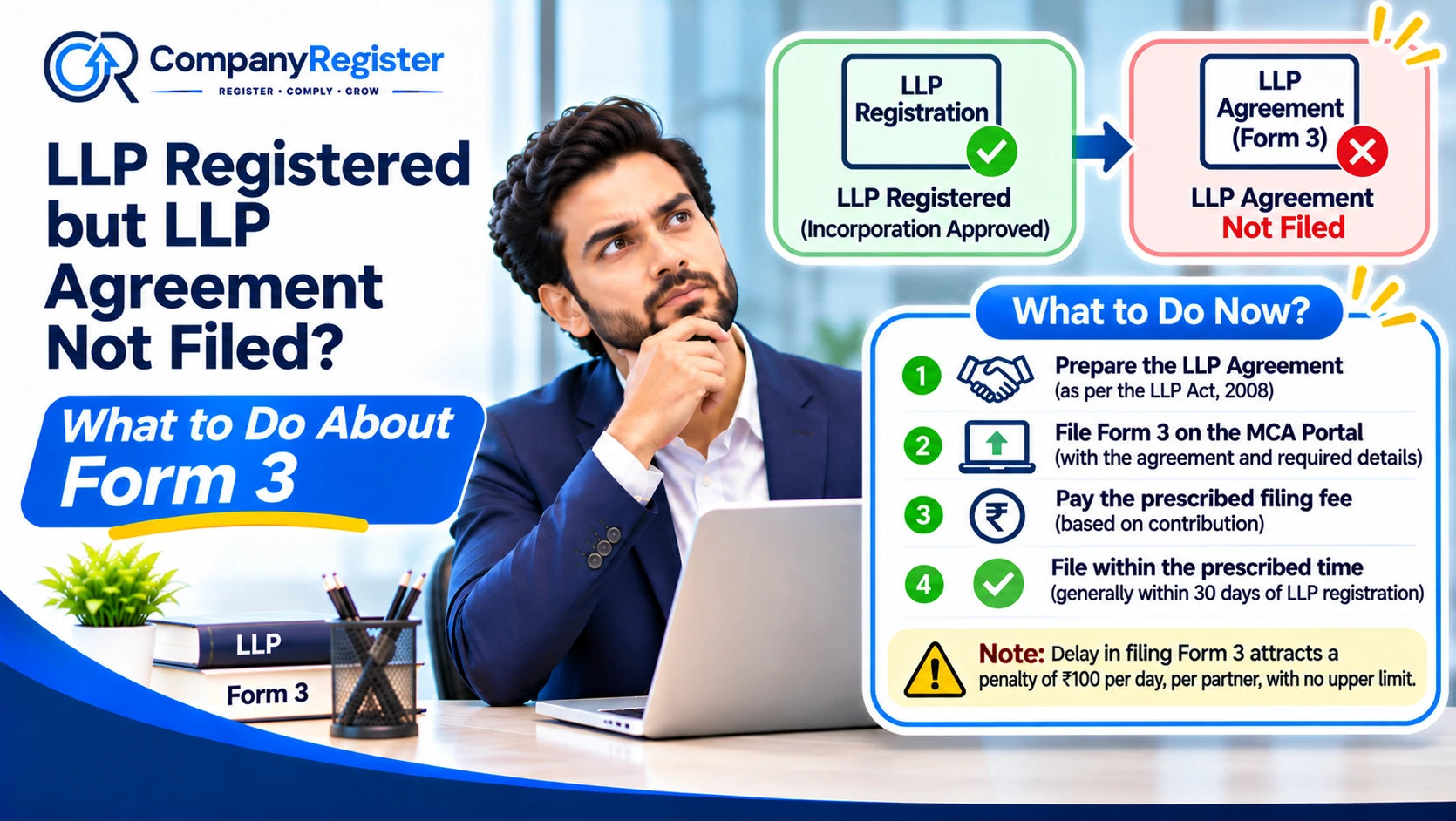
LLP Registered but LLP Agreement Not Filed? What to Do About Form 3
Identify an unfiled LLP agreement, prepare Form 3 on MCA21, separate filing costs from stamp duty and track the submission.
 23 Nov 2026 - Licenses
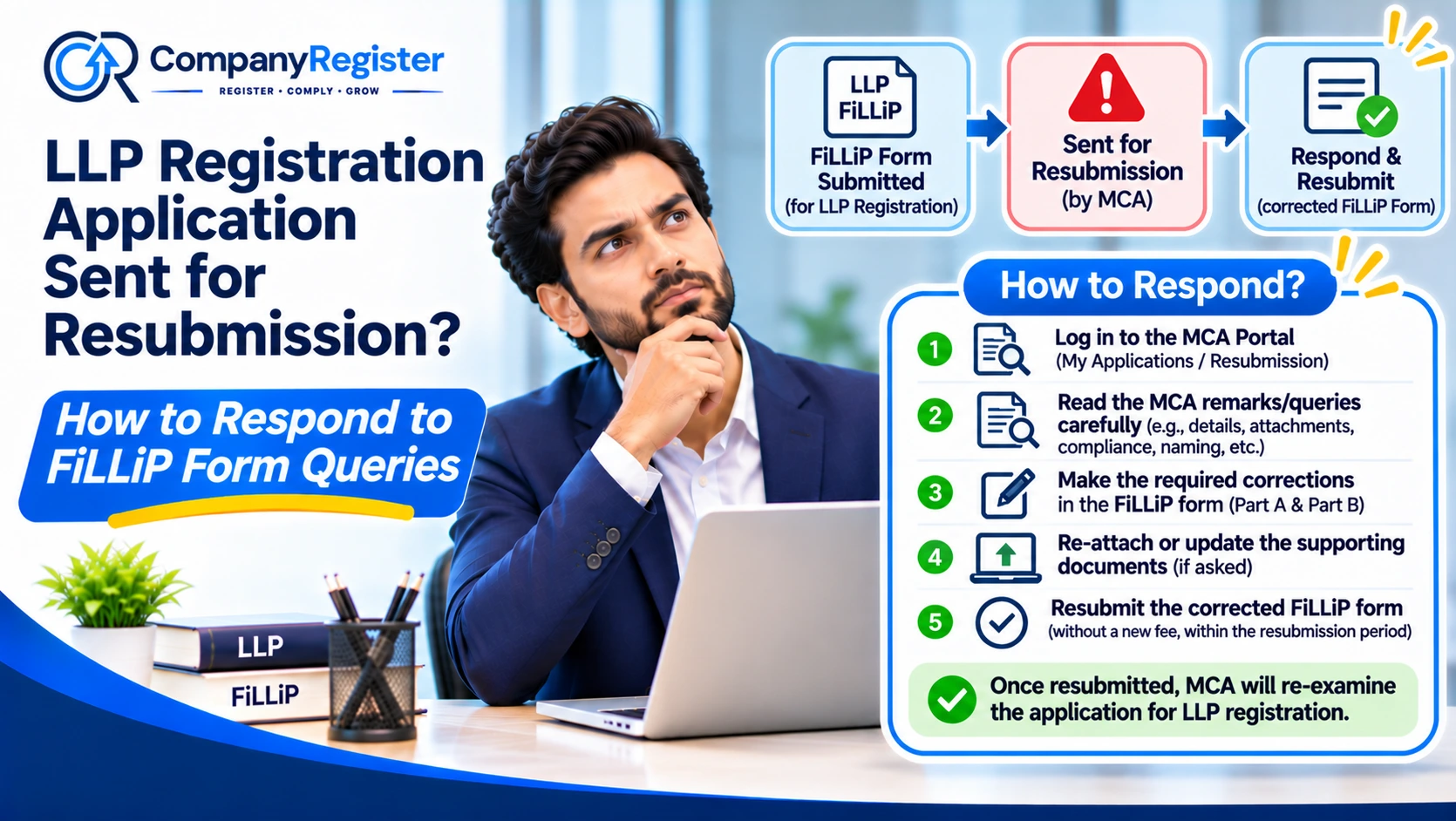
LLP Registration Application Sent for Resubmission? How to Respond to FiLLiP Form Queries
Respond to MCA FiLLiP remarks with a correction plan, relevant documents and portal submission steps. Understand costs, deadlines and next steps.