
One Partner Has Left Your LLP: What Should You Do If Only One Partner Remains?
23 Nov 2026 - Licenses
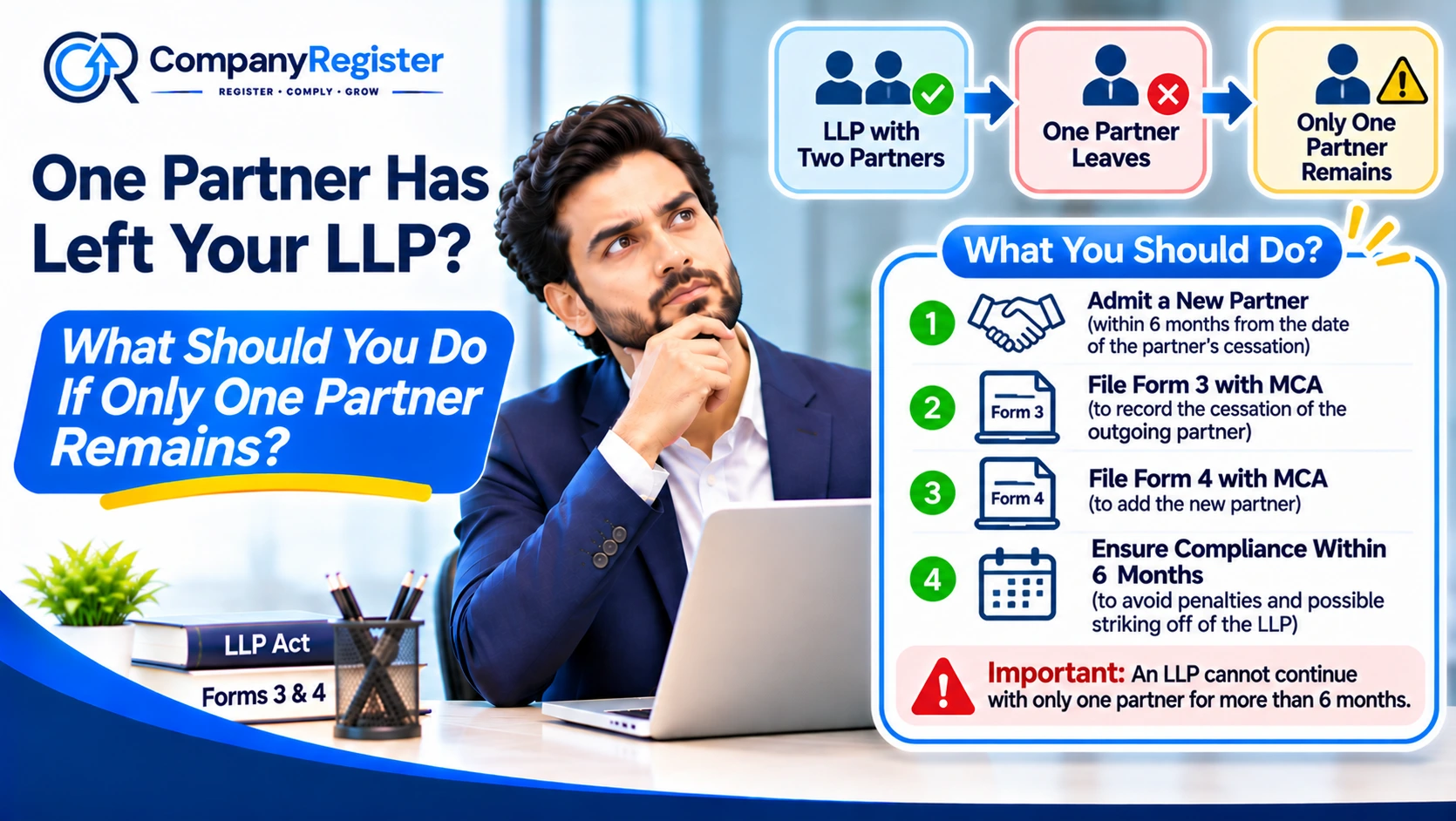
If your LLP has only one partner remaining, establish when the other partner ceased to be a partner and arrange for another eligible partner to join. Report the changes to the Registrar through the applicable MCA filings, and check the separate requirement for designated partners. Do not treat six months as a filing deadline or as permission to postpone action.
The LLP continues to exist as a separate legal entity, but a prolonged one-partner period can expose the remaining partner to personal liability for certain LLP obligations. The immediate task is to establish the facts, identify the relevant dates and preserve evidence of every step.
1. LLP only one partner remaining: what the law requires
1.1 The partner count
Section 6 of the Limited Liability Partnership Act, 2008 requires every LLP to have at least two partners. An LLP in India cannot permanently operate as a single-partner LLP simply because one founder wants to carry on the business alone.
Section 6 also addresses a particular risk when the number falls below two. If the LLP carries on business for more than six months while it has only one partner, and that partner knows this, the partner can become personally liable for LLP obligations incurred during that period. The scope of that liability is explained below.
A partner is not necessarily an equal owner in economic terms. The LLP agreement can allocate contributions, profit shares and management responsibilities differently, subject to the law. A proposed replacement should therefore be chosen for a genuine business relationship, not merely to supply a name for a form.
1.2 The separate designated-partner test
Section 7 requires an LLP to have at least two designated partners who are individuals, with at least one resident in India. Where a body corporate is a partner, individuals may act as its nominees as provided in that section. Designated partners carry specific compliance responsibilities; being a partner and being a designated partner are related but different roles.
Count both categories after the exit. For example, adding an ordinary partner may restore the total to two while leaving only one designated partner. The appointment decision must address each shortfall, including the resident-in-India requirement.
Section 7 also provides for appointment of a designated partner within 30 days of a vacancy. Section 9 deals with situations where there is no designated partner or only one designated partner. A surviving designated partner should not assume the other statutory duties have disappeared because a colleague has left.
2. Who has left, and when did the exit take effect?
The date someone stops working in the business is not necessarily the date that person ceases to be an LLP partner. Start with the LLP agreement and the records of the particular event. The answer affects which changes must be reported and when the one-partner period began.
2.1 Resignation or retirement
Section 24 of the LLP Act permits a person to cease to be a partner in accordance with the agreement. In the absence of an agreement on cessation, the section provides for at least 30 days’ written notice to the other partners. Read any notice together with the agreement, proof of delivery and any relevant written acceptance or settlement.
Separate three questions: whether notice was validly given, the date partnership actually ended, and whether money is still owed between the LLP and the former partner. A pending settlement does not by itself answer the first two questions. Equally, a private conversation about leaving is a poor substitute for a documented event.
2.2 Death, removal or a disputed exit
Section 24 also identifies events, including death, that cause cessation. A removal must be assessed against the agreement and applicable law; a remaining partner should not assume that a disagreement alone removes the other person. Where the event or date is contested, retain the competing records rather than selecting a convenient date for the filing.
Establishing the status may require reviewing the original agreement, later amendments and correspondence with the outgoing partner or their representatives. The LLP’s MCA record is useful evidence of what has been reported, but it should be compared with the underlying documents rather than treated as the only evidence of the transaction.
3. Build a deadline and evidence calendar
Use the actual date of each event as the starting point. Admission, cessation, an agreement change and a designated-partner vacancy can occur on different dates, so one shared deadline may be misleading.
Event or obligation | Timing rule | Evidence to keep |
|---|---|---|
Partner cessation or admission | Section 25 requires the LLP to notify the Registrar within 30 days of the change. | Event records, Form 4 filing and MCA acknowledgement or processing record. |
Change to the LLP agreement | Rule 21 of the LLP Rules requires changes to the agreement to be filed within 30 days. | Executed agreement or amendment, Form 3 filing and MCA outcome. |
Designated-partner vacancy | Section 7 provides for appointment within 30 days of the vacancy. | Appointment records and the relevant filing outcome. |
Business carried on with one partner | Section 6 addresses business carried on for more than six months with one partner, subject to the remaining partner’s knowledge. | Reliable cessation and admission records, plus business and obligation records for the intervening period. |
The six-month provision is a liability rule, not a substitute for the shorter filing and appointment requirements. Enter each actual trigger date in your calendar as soon as it is established. Where a filing has already missed its deadline, record the missed date rather than changing the transaction date to make the filing appear timely.
An acknowledgement shows that a submission or payment has been made; it does not necessarily show that a filing has been approved. Keep the Service Request Number and follow the MCA status through to the recorded outcome. If the portal asks for resubmission, retain the query and the response as part of the compliance trail.
4. Documents to prepare for the change
Build one working file before entering data on MCA21. The exact attachments depend on the event, the current form instructions and the LLP’s circumstances; the following are the records a reader should assemble or assess, rather than a claim that every item is mandatory in every case.
LLP constitution: the LLP agreement, previous amendments and details of the existing partners and designated partners.
Exit evidence: the resignation or retirement notice and delivery evidence, or records supporting the other cause of cessation.
Admission particulars: the incoming partner’s identity and address particulars, proposed role and consent, supported by documents appropriate to the applicable filing.
Commercial terms: agreed contribution, profit and loss sharing, management rights, effective date and the treatment of the outgoing partner’s interest.
Agreement amendment: an executed supplementary agreement where the existing agreement is being changed, with stamping addressed as applicable.
Filing access: authorised signatory details, the relevant digital signature and designated-partner identification details where required for the appointment or filing.
Use consistent names, identification details and dates across the documents. If an individual is to become a designated partner, establish whether the person already has the required identification and can complete the applicable consent and appointment formalities. A partner who is a body corporate requires attention to the entity’s details and any individual nominee arrangements.
Keep the outgoing partner’s settlement papers separate from the admission papers, even when both events are recorded in one agreement. This makes it easier to identify what was agreed with each person and what remains unpaid or disputed.
5. How to add a partner and report the exit on MCA
5.1 Follow the agreement and settle the terms
Admission is a legal and commercial decision before it is a portal transaction. Review the agreement’s admission mechanism, the authority to make decisions and any provisions on contributions or profit sharing. The First Schedule to the LLP Act can apply to matters not covered by an agreement; its admission provision requires the consent of all existing partners.
Agree what the incoming person is undertaking and what the LLP is offering. The proposed partner should understand the existing business position, including material contracts, borrowings, tax matters and disputes. A change in partner composition does not erase obligations already belonging to the LLP.
5.2 Complete the transaction and filings
Identify the effective events. Establish the cessation date, the proposed admission date and whether a designated-partner appointment is also needed. Do not report a proposed appointment as an event that has already happened.
Complete the underlying approvals and documents. Obtain the required consents, document the agreed terms and execute any amendment to the LLP agreement. Address the outgoing partner’s settlement separately if it is not yet final.
Prepare the MCA forms. Form 4 reports changes in partners or designated partners, including cessation and appointment as applicable. Form 3 reports an LLP agreement and changes to it. A partner change and an agreement change are related, but they are not identical events.
File through MCA21. Use the current portal workflow and form instructions for the events being reported. The appropriate sequencing or linking of forms depends on the transaction and portal requirements; do not assume that one filing automatically completes the other.
Track the outcome. Pay the applicable charges, save the submission references and monitor the filing status. Respond to any resubmission request and retain the final outcome alongside the signed records.
Reconcile the result. Compare the reported partner and designated-partner particulars with the documents and the LLP’s intended structure. Investigate a mismatch rather than assuming a successful payment corrected it.
If the planned exit has not yet taken effect, the parties may consider whether the incoming partner can be admitted before the outgoing partner leaves. That approach requires the relevant consents and properly documented effective dates; it is not a way to backdate an event that has already occurred.
Where no suitable signatory is available, the practical filing route deserves attention before documents are executed. An outgoing person’s willingness to assist, the incoming designated partner’s status and portal validations can affect how a particular transaction is completed. Keep the underlying events truthful even if the filing requires separate submissions.
6. Costs to budget before filing
Ask for an itemised estimate rather than one combined “partner change” price. The government charge is only one part of the transaction, and a quote for preparing forms may not include the cost of settling the former partner’s interest.
Cost component | What to ask about |
|---|---|
MCA filing charges | The applicable charge for each form and event in the proposed filing. |
Additional filing fees | Whether a deadline has been missed and what the portal calculates for the delayed submission. |
Stamp duty | The duty applicable to the agreement or amendment in the relevant circumstances. |
Professional charges | Whether drafting, filing, certification where required, resubmission and follow-up are included. |
Transaction and settlement costs | Any agreed payment to the outgoing partner and costs of documenting or funding it. |
Do not budget for a late filing using an old fee chart. The amount depends on the applicable rules, filing details and delay. Before payment, read the MCA payment summary and compare it with the scope of any professional quote. A government filing fee is not the same thing as a statutory penalty, and the two should not be described interchangeably.
7. What happens if the gap continues?
7.1 Personal liability under Section 6
Under Section 6, if an LLP carries on business for more than six months with only one partner, a person who is the sole partner during that period and knows that fact is personally liable for the obligations of the LLP incurred during that period.
The conditions matter: the LLP must carry on business, the period must exceed six months, and the remaining partner must know that the LLP has only one partner. The provision is concerned with obligations incurred during the specified period; it should not be presented as automatically making the partner personally liable for every debt the LLP has ever owed.
Hypothetical: An LLP’s second partner validly leaves, the remaining partner knows it, and the business continues without a replacement beyond six months. An obligation incurred during the relevant period can bring Section 6 into play. The example does not establish that an unrelated earlier obligation automatically becomes the remaining partner’s personal debt under that section.
7.2 Outgoing partner and third-party exposure
Section 24 has a separate rule about how a former partner may be regarded by someone dealing with the LLP. Notice of the cessation matters to third parties, including whether the person dealing with the LLP knows of the cessation or notice has been delivered to the Registrar. Cessation also does not, by itself, discharge obligations incurred while the person was a partner.
Accordingly, an exit is not complete merely because the partners have stopped working together. The former partner and LLP should preserve evidence of the event and its notification, while dealing separately with existing guarantees, contracts and other commitments according to their terms.
8. Common filing and handover mistakes
Using a convenient effective date. A form date should follow the underlying transaction. If the supporting records conflict, resolve the factual discrepancy and preserve the explanation instead of editing dates to avoid a late filing.
Treating payment as approval. A payment receipt proves payment, not necessarily completion of processing. Use the service request record to identify whether the form is pending, needs resubmission or has reached its final outcome.
Assuming the new partner replaces the old partner in every role. A partner appointment, designated-partner appointment, banking authority and contractual signing authority are distinct matters. Map each role to a person and update the relevant records.
Ignoring a missing LLP filing. If the LLP does not report a cessation, Section 25 provides a route for a former partner to notify the Registrar, subject to the statutory procedure. The Registrar may seek confirmation from the LLP; this route should not be treated as an automatic substitute for the LLP’s own duty.
Leaving a settlement undocumented. Record what is agreed, when payment is due and what remains disputed. An amount recorded as a capital contribution is not, without reviewing the agreement and accounts, necessarily the final settlement figure.
Sharing credentials during handover. Give the appropriate person their own authorised access and remove access that is no longer needed. Keep an audit trail of who can sign or submit on behalf of the LLP.
A former partner who remains shown on MCA should collect the exit evidence and the LLP’s filing correspondence before pursuing correction. A filing dispute and a dispute over money may proceed on different tracks; neither should be concealed by an inaccurate form.
9. After the partner change: keep the LLP operational
Assign a named owner to each recurring compliance task. Section 34 of the LLP Act addresses maintenance of books and the Statement of Account and Solvency; Section 35 addresses the annual return. Partner replacement does not pause the LLP’s accounting, return-filing or tax responsibilities.
Review the current status of LLP Form 8 and Form 11, along with applicable tax and other registrations. The person taking over should know the accounting records’ location, pending queries, professional contacts and any outstanding filing work. A clean partner record alone does not establish that annual compliance is current.
Operational access needs its own handover. Review bank mandates, payment approvals, accounting software, licences and important customer or supplier contacts. Where an institution requires its own update, the MCA filing does not automatically change that institution’s records.
Keep a permanent transaction file containing the signed documents, MCA references, processing outcome and communications about the exit. It will be useful when preparing accounts, responding to a counterparty or explaining a historical change to a future partner.
10. Your decision and action list
If the exit is planned but not yet effective, agree the incoming partner’s role and complete the necessary documentation before choosing the transition dates. If the exit has already happened, establish its effective date first and work from the actual filing and appointment deadlines. If the exit is disputed, preserve both sides’ evidence and avoid presenting an unresolved date as settled fact.
On MCA21, review the LLP’s recorded partners, designated partners and outstanding filing status against the signed records.
Enter the actual cessation, admission, agreement-change and designated-partner vacancy dates in a calendar. Apply the relevant 30-day rules and separately monitor the Section 6 six-month period.
Prepare and submit Form 4 for the applicable partner changes and Form 3 for an agreement change, using the current MCA workflow. Retain the submission references and final outcomes.
Assign responsibility for ongoing Form 8, Form 11, tax and operational handover work. Obtain an itemised estimate for any overdue or proposed filing.
Company Register focuses on LLP registration and MCA compliance if you need assistance organising the filing work. Review your current compliance status and take corrective action before the due date
Need personalised advice for your business?
Share your query and our compliance team will connect with you shortly.
Frequently Asked Questions
Can an LLP continue with only one partner?
Does the six-month rule make the remaining partner liable for every LLP debt?
Is adding an ordinary partner enough if only one designated partner remains?
When does an LLP partner's resignation take effect?
Which MCA forms are used for an LLP partner change?
What can a former partner do if the LLP does not report the exit?
Does resignation cancel an outgoing partner's old obligations?
Can the remaining partner close the LLP instead of admitting a replacement?
Recent Blogs
 23 Nov 2026 - Licenses
LLP Registered but LLP Agreement Not Filed? What to Do About Form 3
Identify an unfiled LLP agreement, prepare Form 3 on MCA21, separate filing costs from stamp duty and track the submission.
 23 Nov 2026 - Licenses
LLP Registration Application Sent for Resubmission? How to Respond to FiLLiP Form Queries
Respond to MCA FiLLiP remarks with a correction plan, relevant documents and portal submission steps. Understand costs, deadlines and next steps.
 23 Nov 2026 - Licenses
DSC Not Associated With the MCA Portal? How to Fix the Problem Before Company Registration
Identify the MCA DSC association error, prepare signatory details, follow the portal workflow and distinguish certificate costs from incorporation fees.