
How to Choose the Right Shareholding Structure for a Startup
14 Nov 2026 - Registrations

Choose a startup shareholding structure by agreeing what each founder contributes, allocating shares against those contributions, and modelling how future investors and employee options will change ownership. Then document the voting, exit and decision rules before entering the initial share allocation in the incorporation filings.
For most first-time founders planning to issue shares, the immediate choice is a private limited company or, for an eligible solo founder, an One Person Company. The right percentages depend on commitment and fundraising plans; an attractive split on day one can still create a costly deadlock or an unexpected loss of control later.
What a startup shareholding structure actually decides
Issued capital and ownership
A startup ownership structure records who holds the company’s shares, how many they hold and the rights attached to those shares. If a company has issued 10,000 ordinary equity shares and a founder owns 6,000, that founder holds 60% of those issued shares. The calculation changes when additional shares are issued or existing shares are transferred.
Authorised share capital is the ceiling stated in the company’s constitutional documents; issued capital is the portion the company has actually issued. A company can have headroom within its authorised capital without having given that headroom to anyone. A future increase in authorised capital may involve corporate approvals, filings and costs, so choose the initial figure with a reasonable plan rather than treating it as a founder’s ownership percentage.
Ownership is only one part of control
Equity ownership can carry voting and economic rights, but the exact position depends on the class of shares, the Companies Act, 2013, and the company’s documents. A director manages as part of the board; a shareholder owns shares and votes on shareholder matters. One person can be both, but a board seat does not by itself establish a particular percentage of ownership.
A useful cap table therefore records the holder, number and class of shares, issue price and relevant rights. Keep a separate view of options and other potential claims to shares. That distinction helps founders answer two different questions: “Who owns the company now?” and “What could ownership look like after commitments are exercised?”
Who should use a share-based structure?
Choose the entity first
A private company is relevant when two or more people want to start a company with shares and expect to add investors or employees. Under Section 3 of the Companies Act, 2013, a private company requires at least two members; Section 149 generally requires at least two directors for a private company. A founder can also be a director, subject to the applicable requirements.
An One Person Company has one member and is a different starting point for an eligible individual founder. An LLP has partners and agreed contributions rather than company shares. If the plan depends on issuing investor equity or employee share options, compare those ambitions with the legal form before settling on the simplest incorporation route.
Pre-filing ownership checks
Identify the proposed subscribers, directors and registered office, and decide whether any owner will invest through an entity or from outside India. Foreign participation can introduce separate foreign exchange, pricing and reporting requirements; the route depends on the investor and transaction. Build those requirements into the proposed structure before agreeing a price or closing date.
Company incorporation and Startup India recognition are separate matters. Incorporating through the Ministry of Corporate Affairs, or MCA, does not automatically grant recognition from the Department for Promotion of Industry and Internal Trade, or DPIIT. Founders seeking startup India registration should assess that separate route after identifying the entity and its circumstances.
How to agree a founder equity split
Compare contributions over time
Start with each founder’s expected role for the next few years: time commitment, relevant skills, access to customers, cash invested and responsibility for delivery. Separate work already completed from promises of future work. A founder contributing an existing product should explain who owns its intellectual property and what the company will receive; a founder promising future sales should specify the role rather than attach an unsupported value to a contact list.
Next, record the assumptions behind the proposed split. For example, one founder may accept a smaller initial allocation because another is leaving a paid job to work full time. If those assumptions change, the written record gives the founders a starting point for a negotiated response instead of forcing them to reconstruct the original bargain.
Cash and shares also need separate treatment. A founder who pays an incorporation expense has not automatically acquired additional shares. Decide whether the payment is an expense to be reimbursed, a loan, a contribution towards shares or another arrangement, and record it accordingly.
Decide whether equal ownership fits
An equal founder equity split can be appropriate when contributions, risk and continuing commitments are genuinely comparable. It is less useful when one person is part-time, one has supplied the core product, or the founders expect different levels of responsibility. A contribution matrix cannot produce an objectively correct percentage, but it can expose the assumptions on which a proposed allocation rests.
For two equal founders, agree a deadlock route before disagreement arises. Specify which decisions require joint consent and what happens if neither founder changes position. Mediation, a defined escalation period or a negotiated exit mechanism may be considered; each has different consequences and should be drafted for the business rather than copied as a slogan.
Do not allocate shares to an adviser merely because advice may be useful. Identify the service, expected period and actual deliverables first. A small percentage can become valuable later, while recovering shares from an inactive holder may be difficult or expensive.
Design voting and decision rights
Shareholder votes
Different decisions can need different approval levels. Section 114 of the Companies Act distinguishes ordinary resolutions from special resolutions. For a special resolution, the votes cast in favour must be at least three times the votes cast against, subject to the statutory requirements for that resolution.
Those thresholds concern votes cast, not simply the headline percentages in a cap table. Attendance, abstentions, applicable voting rights and any contractual consent requirements can affect a particular decision. A founder should model a disputed vote using realistic participation rather than assume that an ownership percentage guarantees every outcome.
List the decisions founders consider sensitive: issuing new securities, taking substantial debt, changing the business direction or selling important assets. Then identify which are board matters, shareholder matters or proposed contractual consent matters. Extra vetoes can protect a minority holder, but too many can slow fundraising or ordinary operations.
Board decisions and deadlock
The board’s composition deserves its own discussion. Agree how directors are nominated or replaced, what information they receive and which decisions are reserved for the board. An investor’s request for a board seat should be assessed alongside its information rights and vetoes, not treated as merely another ownership percentage.
Also decide who can run routine operations without bringing every expense back to the founders. Delegation limits and reporting expectations help preserve accountability while allowing the company to act. The final arrangements must work with the Act, the articles and any binding shareholder agreement.
Model dilution before promising equity
Build a fully diluted model
Cap table management starts with two denominators. The issued-share view counts shares already issued. A fully diluted planning view also includes specified potential shares, such as an agreed option pool; its definition should state exactly what is included. An option is not the same as an issued share, and an unallocated pool in a spreadsheet does not by itself make employees shareholders.
Illustrative example: Two founders hold 6,000 and 4,000 issued shares. They model a pool of 2,000 potential employee shares and an issue of 3,000 new shares to an investor. On a fully diluted denominator of 15,000, the founders would have 40% and about 26.67%, the pool about 13.33%, and the investor 20%.
Immediately after the investor receives its shares, assuming no options have been exercised, the issued-share denominator would instead be 13,000. The founders would then hold about 46.15% and 30.77% of issued shares, and the investor about 23.08%. Both views can be useful, provided the table labels them and does not present the potential pool as shares already issued.
Read an investor proposal
For an angel investment or venture capital funding round, ask whether the proposed investor percentage is calculated before or after creating an option pool. Also establish whether that percentage is based on issued shares or a fully diluted basis. The same headline valuation can leave founders with different ownership depending on when the pool is included and what the denominator contains.
Review the price per share, number of new shares, valuation assumptions and any special investor rights together. A transfer by an existing founder changes who owns existing shares; an issue of new shares increases the denominator and can dilute existing holders. A model should show these as different transactions, including who receives the money.
Employee options require a properly designed scheme and applicable approvals. Eligibility restrictions can matter for founders, promoters and directors, with exceptions depending on the circumstances. Do not promise a named person options until the proposed plan has been assessed against the applicable rules.
Put founder promises into workable agreements
Founder vesting
Founder vesting links the founder’s economic entitlement to continued participation or another agreed condition. It can address the risk that someone leaves shortly after incorporation while the remaining founder continues building the business. The parties should agree the duration, any initial waiting period, treatment of a departure and what happens on death, disability or a sale of the company.
There is an important implementation choice: a promise to receive shares later is different from shares issued at incorporation that are subject to agreed transfer or repurchase arrangements. The second approach does not make already issued shares disappear automatically when a founder leaves. Any transfer, pricing, company buyback or other mechanism must be designed around applicable law, the articles and tax consequences.
Shareholder agreement and articles
A shareholder agreement records the bargain among the parties: roles, funding commitments, information rights, transfer restrictions and dispute procedures. It can also address an offer to sell shares, a proposed company sale and the treatment of a departing founder. Define who may buy the shares, how the price is determined and how a transaction will be completed; a general promise that shares will be returned is not enough.
The articles of association govern the company’s internal rules and should be considered alongside that agreement. Where the founders intend restrictions on share transfers or governance rights to operate through the company’s constitution, the drafting should be consistent. Professional help is particularly useful for vesting, enforceability, tax and investor rights because changing an agreed structure later may require consent and a new valuation.
Documents to prepare
Prepare the incorporation material in the format required by the applicable MCA forms. Requirements vary with the type of subscriber, director and registered office; an individual and a corporate subscriber will not necessarily provide the same evidence.
- Subscriber and director particulars, with applicable identity and address evidence: these establish the people entering the company records and the capacity in which they act.
- Registered-office evidence and permission to use the premises, where applicable: these support the company’s stated address rather than establish share ownership.
- Memorandum of association, including the subscription details: this records the company’s objects and the initial subscribers’ share commitments.
- Articles of association: these set the internal rules, including relevant provisions for shares and governance.
- Applicable declarations and consents: these support the proposed incorporation and appointments in the form required for the filing.
- Digital signature certificates for the people required to sign the electronic submission: these enable the prescribed electronic authentication.
Separately prepare an agreed cap table, founder arrangements and any intellectual property assignment needed for the business. These commercial records explain the founders’ bargain; they are not interchangeable with the statutory incorporation documents. If an entity subscribes, its authorisation and signatory details also need to support the proposed subscription.
Step-by-step: from decision to incorporation
- Prepare the commercial plan. Decide the subscribers, numbers and class of shares, initial capital, directors and registered office. Produce an issued-share table and a separate future-dilution model before entering figures into an application.
- Settle the legal documents. Agree the company’s objects and internal rules, then align the founder arrangements with the intended subscription. Resolve unusual investor, foreign ownership or vesting terms before treating the allocation as final.
- Start the MCA21 incorporation application. Use SPICe+ Part A for the proposed name and Part B for incorporation particulars. Enter the subscriber and capital details consistently with the agreed structure.
- Complete the linked incorporation forms that apply. The electronic memorandum and articles are submitted in Forms INC-33 and INC-34 where applicable; AGILE-PRO-S, Form INC-35, handles specified linked registrations and services. The applicable form route can differ with the case.
- Sign, submit and pay through the MCA portal. Retain the application reference and submission records. If the application is sent for resubmission, review the observations and respond through the prescribed route rather than creating a different ownership arrangement informally.
- After approval, review the certificate of incorporation and preserve the filed documents. Complete the initial share and commencement-related actions described under ongoing compliance, and update the cap table to reflect what was actually filed and issued.
Founders who intend to seek DPIIT recognition can pursue that separate application through the Startup India route. Recognition is not a substitute for completing the MCA incorporation process or maintaining the company’s ownership records.
What will the structure and registration cost?
There is no single reliable government fee for every startup company registration. The MCA amount depends on the application and applicable fee rules, while stamp duty depends on the relevant state or union territory and the instrument. Authorised capital and the facts of the filing can affect the calculation; a quote for one startup should not be assumed to apply to another.
Budget separately for digital signatures, professional preparation, drafting a shareholder agreement and any advice on valuation, tax or foreign investment. These are commercial costs, not automatically government charges. Ask for an itemised quote that distinguishes statutory payments, service fees and likely extras, including work arising from a change in the agreed structure.
Changing an allocation after incorporation can have a switching cost even where the founders agree. A transfer or new issue may need valuation or tax analysis, documentation, approvals and updates to records. The cost depends on the chosen transaction, so compare correction routes before assuming that moving a few shares is merely an administrative edit.
How long should founders allow?
Allow time for three separate milestones: reaching an ownership decision, obtaining incorporation approval, and completing the initial obligations after incorporation. The first can take longer than entering data on a portal if founders have not resolved contribution, control or exit terms.
MCA processing time is not a guaranteed incorporation date. Name availability, application complexity, the quality of the submission and any resubmission can affect the interval. A corporate or overseas participant, an unusual capital arrangement or negotiations over investor rights can also lengthen preparation.
Plan any investor closing or commercial launch around these dependencies rather than an assumed approval date. Post-incorporation deadlines run from their relevant legal trigger, so keep the incorporation date and subsequent allotment dates visible in the company’s compliance calendar.
Compliance after the company is incorporated
Under Section 56 of the Companies Act, a company must deliver share certificates for subscribers to the memorandum within the applicable statutory period, generally two months from incorporation. The company must also maintain its register of members under Section 88. Use these records, together with the cap table, to track legal holdings rather than relying only on a founder’s spreadsheet.
For a company with share capital, Section 10A requires a declaration about subscribers’ payment for their shares before commencement of business or exercise of borrowing powers, subject to the section’s conditions. The declaration is filed in Form INC-20A within 180 days of incorporation. Arrange the subscription payments and evidence in time for that obligation.
When the company later allots securities, the applicable approvals and return of allotment matter. Section 39 and the relevant rules provide for filing particulars of allotment, commonly through Form PAS-3, within the prescribed period. A private placement, rights issue or employee option exercise can have additional requirements; use the route that fits the actual transaction.
Annual financial statement and annual return filings are separate from individual share transactions. Keep the register, certificates, board and shareholder records, and filings consistent when holdings change. A cap table is a useful management tool, but it does not replace the statutory register or the documents supporting an allotment or transfer.
Common mistakes and how to correct them
Confusing a promise with an issue. A founder may tell an employee or adviser that they “have 2%” without defining the denominator or the instrument. List every promise, identify whether shares, options or a future negotiation were intended, and document a lawful route before presenting it as ownership.
Using inconsistent incorporation particulars. A mismatch between subscriber names, share numbers, supporting evidence and the application can produce queries or resubmission. Reconcile the source records against the proposed entries before submission; if an observation is raised, correct the identified inconsistency in the resubmission rather than changing unrelated figures.
Leaving intellectual property outside the company. Code, designs or a brand may have been created by a founder or contractor before incorporation. Identify the owner and obtain the appropriate assignment or licence for the business. A share allocation alone does not automatically transfer those assets.
Treating a forecast as a legal record. A fundraising model may contain an investor allocation that was never approved or an option pool that was never created. Preserve dated versions, mark assumptions clearly and update the issued-share view only when the relevant transaction has actually occurred.
Your next three decisions
- If you are a solo founder, decide whether the intended business and future ownership plans fit an OPC. If two or more founders expect to issue shares, assess a private company and agree the initial subscribers.
- If contributions are unequal, write down the proposed split and the assumptions behind it. If ownership is equal, settle a deadlock route. In either case, model a future investor and employee pool before making percentage promises.
- Assemble the incorporation material and arrange targeted legal or tax help for vesting, foreign participation or complex investor rights. Once the figures and documents are ready, choose a filing route.
Begin the process online via the official government portal, or engage Company Register for end-to-end assistance
Need personalised advice for your business?
Share your query and our compliance team will connect with you shortly.
Frequently Asked Questions
How should startup founders divide shares?
Can two founders own a private company equally?
Does reserving an employee option pool immediately dilute founders?
What is the difference between issued and fully diluted ownership?
Is a shareholder agreement the same as the articles of association?
Which MCA form is used to incorporate a private company?
Does company incorporation automatically grant Startup India recognition?
What happens to a founder's shares if they leave?
Recent Blogs
 20 Nov 2026 - Licenses
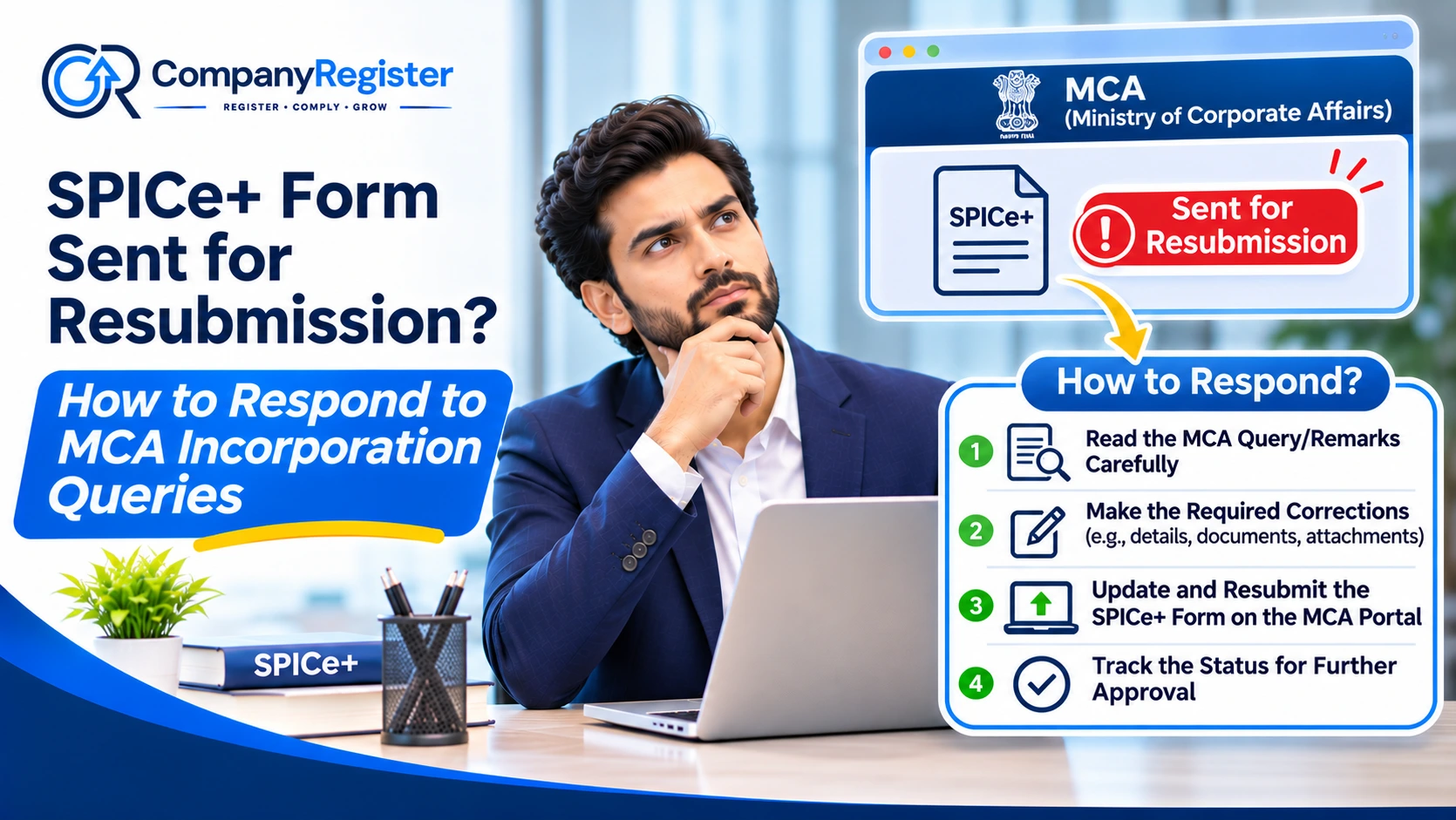
SPICe+ Form Sent for Resubmission? How to Respond to MCA Incorporation Queries
Respond to MCA incorporation remarks with a document checklist, MCA21 steps, a cost breakdown, deadline guidance and post-incorporation duties.
 20 Nov 2026 - Licenses
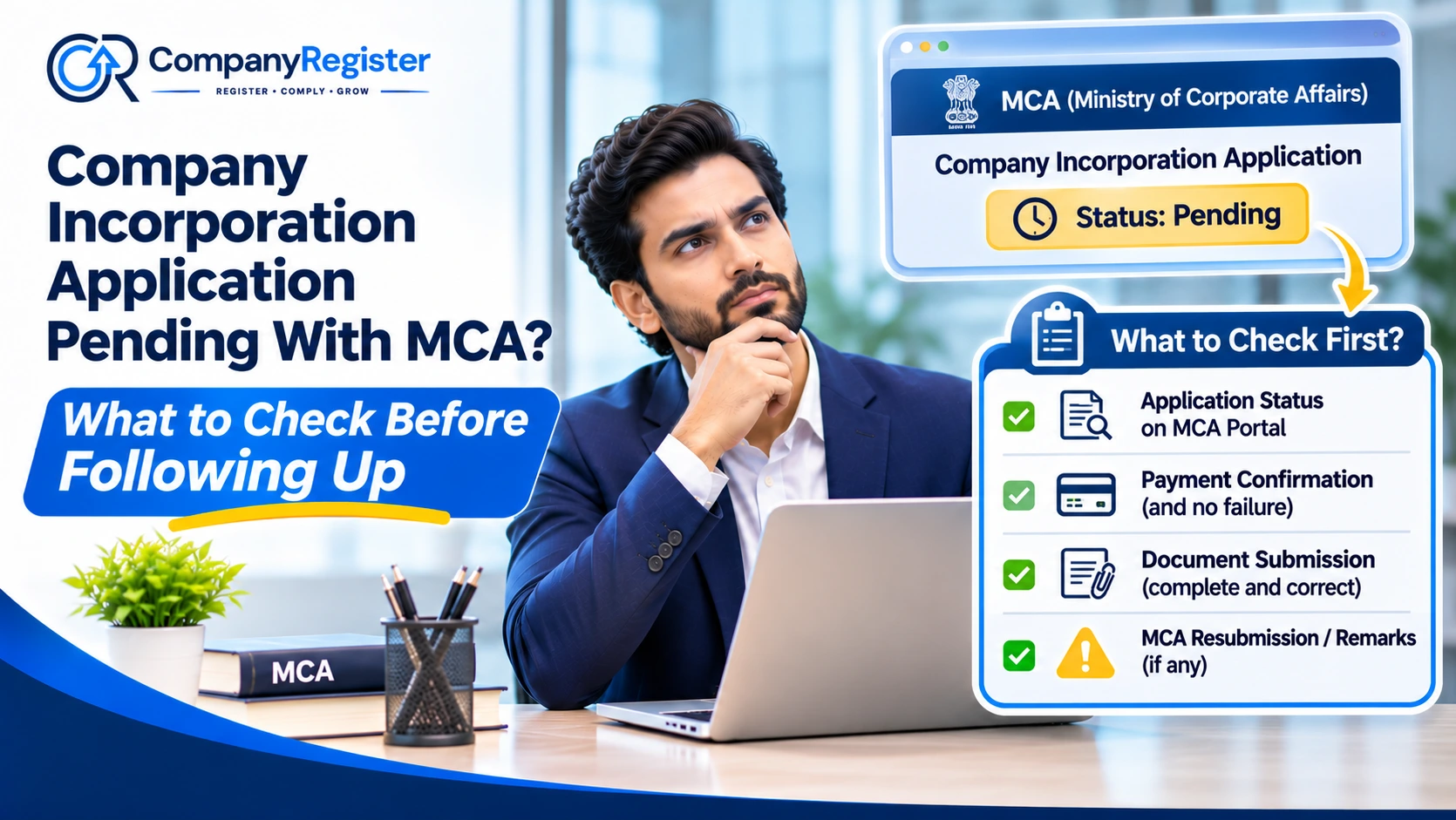
Company Incorporation Application Pending With MCA? What to Check Before Following Up
Check your MCA incorporation status, SRN and payment before following up. Understand SPICe+ documents, costs, processing stages and next steps.
 20 Nov 2026 - Licenses
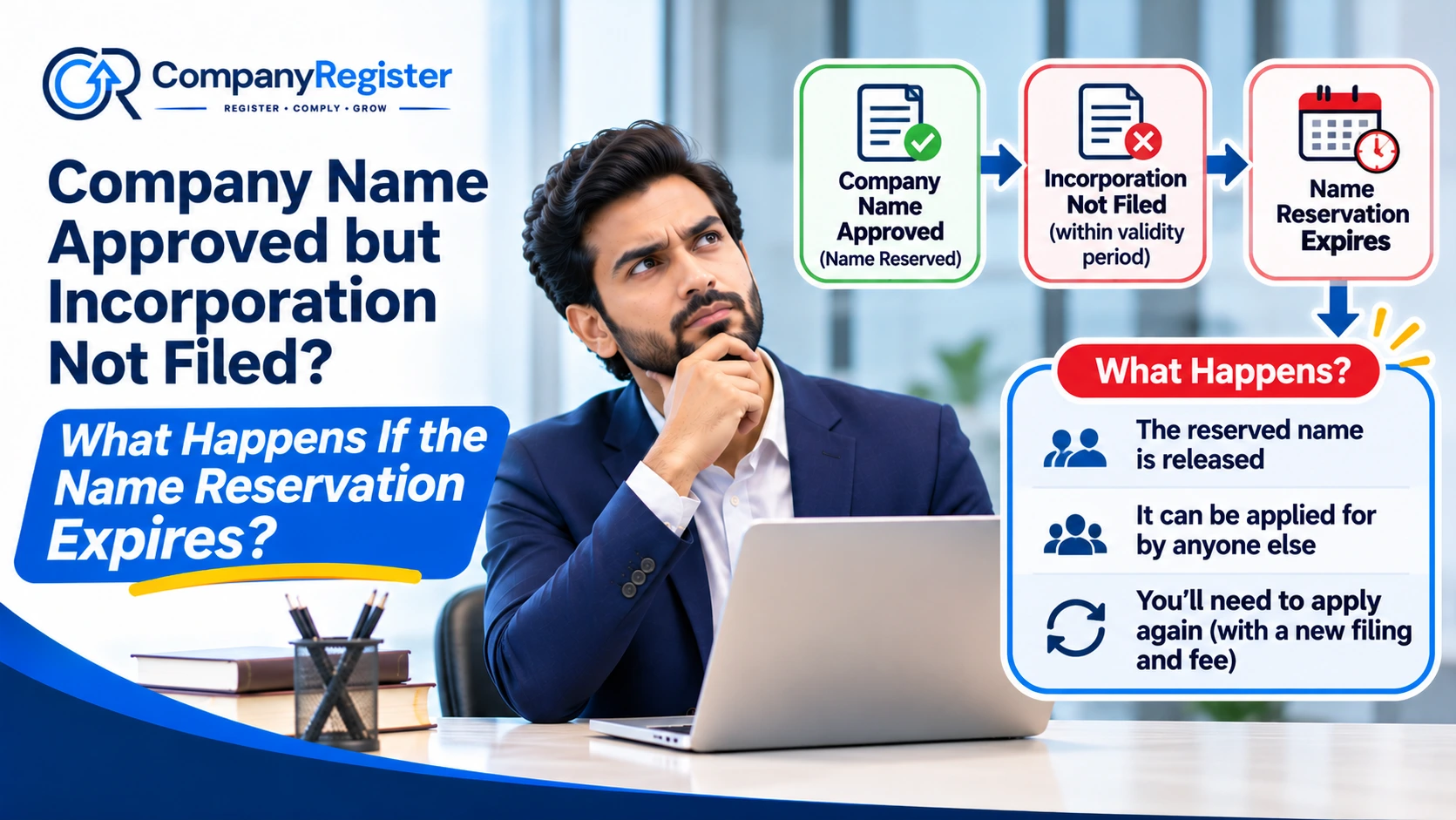
Company Name Approved but Incorporation Not Filed? What Happens If the Name Reservation Expires?
Learn when a reserved company name lapses, whether to extend or reapply, and what to prepare for SPICe+ filing, fees and incorporation.