
Company Incorporation Application Pending With MCA? What to Check Before Following Up
20 Nov 2026 - Licenses
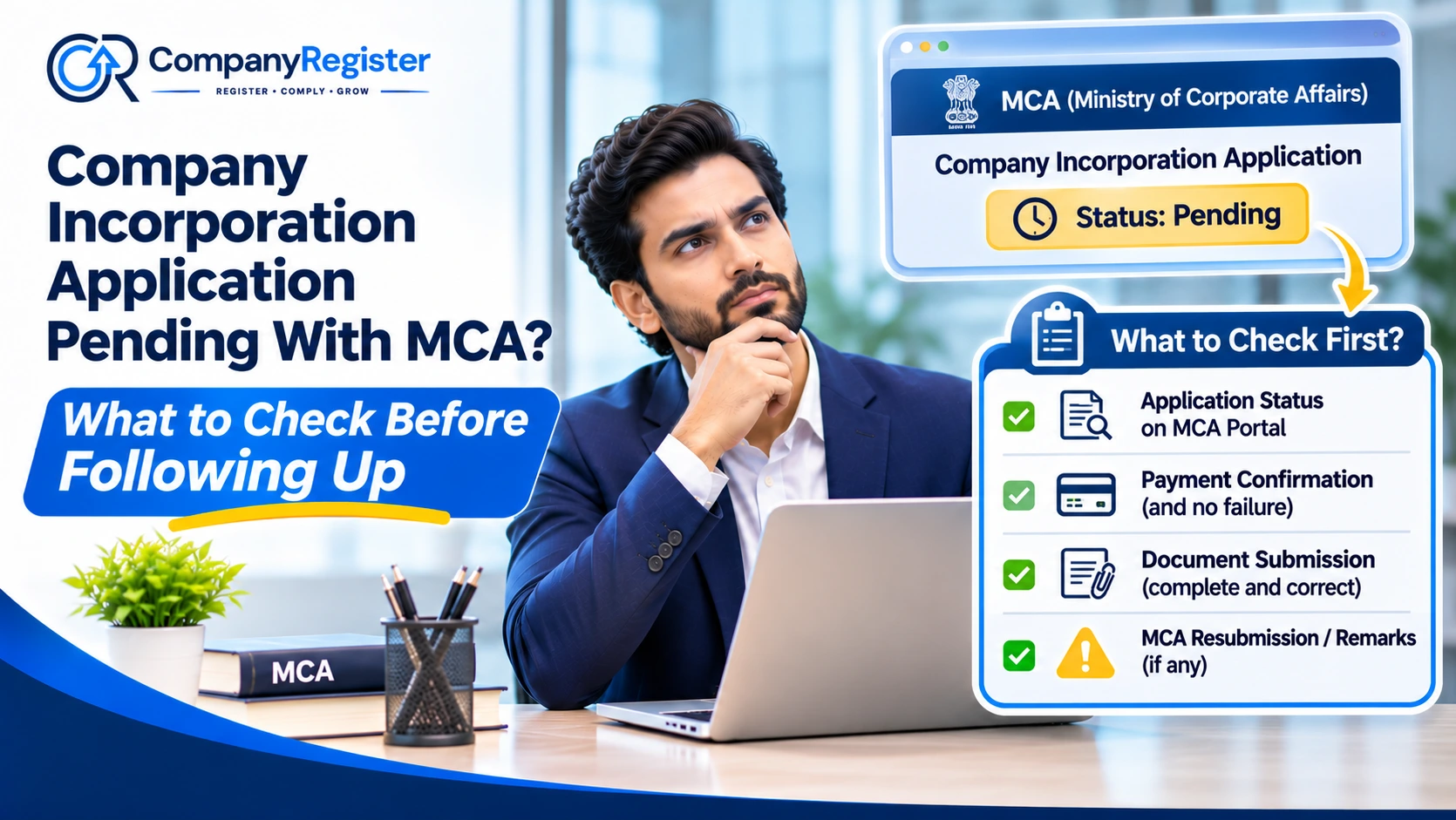
If your MCA incorporation application is pending, first identify the exact filing, its service request number (SRN), payment outcome and current status on MCA21. Follow up only after you know whether the application is still a draft, awaiting payment, under scrutiny or requires action from you; each situation needs a different response.
For a first-time founder, a long silence can make it tempting to file again or pay a second time. Before doing either, collect the transaction record and ask the person who submitted it what action, if any, the portal or MCA has requested. This guide also explains the route for founders who have prepared an application but have not yet submitted it.
1. MCA incorporation application pending: what the status means
A pending application is a description of a stage, not proof that the proposed company exists. The service request number identifies a transaction; it does not by itself establish that incorporation has been approved. The certificate of incorporation is the formal document to look for when the application is granted under Section 7 of the Companies Act, 2013.
There are several points at which a founder may say an application is “with MCA”. A professional may still be preparing it, the portal may be awaiting payment, or a submitted filing may be under processing. A filing returned for resubmission is also unresolved, but it requires a response rather than passive waiting.
1.1 Identify the stage before contacting MCA
What the record suggests | What it means for your next decision |
|---|---|
Draft or preparation work | Find out what remains to be completed before submission; there may be no application under scrutiny yet. |
Payment unresolved | Compare the portal record with the payment evidence before making another payment. |
Submitted and under processing | Record the latest status and any communication; a submitted application is not yet an incorporated company. |
Action or resubmission requested | Read the actual communication and its deadline, then arrange the requested response. |
Approved | Obtain the certificate and move to the company’s post-incorporation obligations. |
Portal wording and available details can differ by transaction. Record the words actually displayed rather than treating this table as an exhaustive list of MCA status labels. If a professional says “company registration under scrutiny”, ask for the current portal record and the SRN to which that description refers.
1.2 Read the status with the filing history
One incorporation project can involve more than one transaction. A name-related filing and the incorporation filing may have different references or outcomes, depending on how the application was made. An approved name is useful, but it is not the same document as a certificate of incorporation.
Ask the filing professional to identify which reference relates to which application. That simple distinction prevents a founder from following up on a name transaction when the concern is the incorporation filing, or from assuming that a name approval means the entire process is complete.
2. Who can use the incorporation route?
Eligibility matters when deciding whether to start or continue a company filing. It is separate from access to an existing status record: a founder may need the submitting account holder’s help to obtain information even when the founder is a proposed director or shareholder.
2.1 Choose the company type
Private company: Section 3 of the Companies Act permits formation by two or more persons. Section 149 requires a private company to have at least two directors.
One Person Company: Section 3 provides for formation by one person as a company of this type. Its specific statutory conditions and nominee arrangements must fit the proposed structure.
Other company types: A public company and a company formed for charitable or similar objects have different requirements. Do not assume that a private-company checklist covers them.
The company’s proposed activities also matter. A sector-specific licence or approval may be needed for an intended business; incorporation alone should not be treated as permission to carry on every regulated activity. Decide what the company will actually do before settling its objects and structure.
2.2 Check the proposed participants
Identify the initial subscribers, who agree to take shares, and the proposed directors, who will manage the company. The same person can have both roles, but the roles are not interchangeable. Each participant must be eligible for the role proposed, and the company must satisfy the applicable resident-director requirement under Section 149.
A proposed director should also consider whether any statutory disqualification applies under Section 164. An existing director identification number, where applicable, and digital signing arrangements should be identified before filing. A pending status does not itself resolve an eligibility issue that existed when the application was prepared.
If you have chosen a private company and want assistance with the complete filing, explore Private Limited Company Registration. The service is relevant to the incorporation route; it does not change the legal conditions applicable to the proposed company.
3. Documents and records to assemble
Use two separate folders: one for the incorporation documents and another for the transaction history. The first supports the application’s contents. The second helps establish what was submitted, when it was submitted and what response has arrived.
3.1 For a new incorporation filing
Identity and address evidence: Applicable identity and residential address records for subscribers and proposed directors support the particulars entered in the filing. Indian participants commonly use PAN details; the supporting evidence and format depend on the person and the filing circumstances.
Registered-office evidence: Premises-related proof and the occupier or owner’s permission, as applicable, support the proposed registered-office address and the company’s right to use it.
Constitutional documents: The memorandum of association states the company’s objects and other foundational particulars; the articles of association contain its internal rules. SPICe+ has linked electronic memorandum and articles forms for cases where those forms apply.
Declarations and consents: The filing calls for applicable subscriber and director declarations and consents. Their purpose is to put the required statements and willingness to act on record.
Digital signatures: A valid digital signature certificate enables the relevant person to sign electronically. It is a signing tool, not a substitute for the underlying evidence.
Provide readable electronic copies in the format accepted for the relevant attachment or linked form. Foreign participants, corporate subscribers and special company types can require different evidence or execution formalities; the ordinary domestic checklist should not be treated as universal. Keep the final signed set as well as the source documents used to prepare it.
3.2 For an existing application
Collect the SRN, a copy of the submitted application and linked forms, the payment receipt or bank transaction reference, and any MCA incorporation acknowledgement. Save the latest status display and correspondence with the filing professional. If MCA has issued a communication, retain the complete notice, including its date and any response deadline.
An acknowledgement, a payment record and an approval certificate serve different purposes. Keep each in its own right rather than relying on a verbal update. A payment debit can help trace a transaction, while the portal record helps establish how that transaction is reflected in the application.
4. How to file and check an application on MCA21
The answer to “what is the procedure to register a company?” depends on whether you are starting a filing or tracking one already made. MCA21 is the Ministry of Corporate Affairs’ online portal; SPICe+ is the integrated incorporation application, also identified as Form INC-32.
4.1 If incorporation has not yet been submitted
Settle the proposed company type, participants, business objects and name choices. Obtain the applicable evidence and signing arrangements before treating the application as ready for filing.
Access MCA21 and prepare SPICe+. Part A deals with the proposed name and Part B with incorporation particulars. The route through the parts depends on how the application is being made.
Complete the applicable linked forms. These can include the electronic memorandum in INC-33, electronic articles in INC-34, and AGILE-PRO-S for integrated registrations and services, where applicable. The precise set depends on the case.
Review the completed forms and attachments, arrange the required signatures and certification, submit the filing and pay the amount shown for the transaction. Preserve the resulting transaction and payment records.
After submission, use the relevant SRN and account records to monitor the filing. If an official communication asks for action, read its terms and respond within the stated window.
Preparation is not submission. A consultant’s draft, a proposed name or an unsigned form does not show that MCA has received a completed incorporation application. Ask for the final submitted version rather than relying only on the version circulated for review.
4.2 If a filing already has an SRN
For a SPICe Plus application status check, use the MCA21 account and the portal’s available application or SRN tracking functions. If you did not make the filing yourself, ask the submitting professional for the current status and a copy of the relevant record. The MCA portal My Application status view, where available to the account, is useful for viewing the filing in context.
For MCA SRN status tracking, match the reference to the incorporation transaction before interpreting its result. Record the status text, the date viewed and any communication shown alongside it. If several references exist, label them in your records by purpose instead of assuming that the latest reference covers every part of the project.
A returned filing needs a response to the actual MCA communication, not a generic replacement application. Ask who will prepare and submit the response and who will review it. The notice and the applicable portal instructions determine what can be done in that case.
5. Government charges and professional costs
There is no single reliable amount to quote for every proposed company. The government cost depends on the transaction and applicable filing and stamp-duty rules; professional charges depend on the agreed work. The portal’s transaction calculation and the professional’s written quotation answer different questions.
Cost item | What to ask for |
|---|---|
Government filing charges, where applicable | The amount calculated for the particular application and a receipt or transaction record. |
Stamp duty, where applicable | The amount included in the filing calculation and the relevant jurisdiction used for it. |
Digital signature costs | Whether obtaining or renewing certificates is included in the quoted service. |
Professional service charges | The fee for preparation, review, filing and any separately charged follow-up work. |
Corrections or additional work | Whether responding to a query or changing the agreed filing scope will attract a further charge. |
A quotation should say whether government payments are included or reimbursed at actuals. It should also identify who will pay them, who receives the receipt and whether the quoted fee covers communications after submission. A low initial price can be hard to compare with another quote if one excludes signing, revisions or follow-up.
Ask for a transaction-wise statement, not just a total project invoice. If a payment looks unresolved, the statement helps distinguish money paid to a professional from money recorded against the MCA transaction.
A pending application does not automatically create a new government charge. Equally, do not assume that a new filing, a changed scope or professional work on a query will be free. Establish the nature of the proposed expense before authorising it.
6. Processing time: which clock are you measuring?
There is no verified universal number of days in the supplied official material for every incorporation outcome, so a single promised approval time would be misleading. A useful timeline starts with dated milestones and shows which part of the project is actually taking time.
6.1 Build a milestone record
Preparation period: The time spent collecting information, completing forms and arranging signatures before submission.
Submission and payment: The date the relevant transaction was submitted and the date payment was recorded.
Scrutiny period: The period after submission while the filing awaits an outcome or communication.
Applicant response period: Any time between an MCA query and the filing of the required response.
Outcome: The date of approval, rejection or another recorded disposition.
These periods should not be combined into one unexplained “MCA company registration delay”. For example, a project may have started weeks ago even though the complete filing was submitted more recently. Conversely, an application submitted some time ago may need attention if an MCA communication has already requested a response.
6.2 What changes the elapsed time
The time taken can vary with the completeness and nature of the filing, the need for clarification, the applicant’s response and portal or payment issues. Workload and case-specific scrutiny may also affect the interval. An unchanged display alone does not reveal which of these factors, if any, is responsible.
If an MCA application has been pending for weeks, establish the last meaningful event and whether a deadline is running. A professional’s original estimate can be compared with the actual submission date, but an estimate is not the same as a statutory deadline or an official service commitment. Use that distinction when deciding whether to send a follow-up.
7. How to follow up or raise a grievance
Make the request specific enough for the recipient to identify the transaction and the problem. “Please expedite my company” gives little information; a short record of the application, payment and status gives the recipient a clearer starting point.
7.1 Choose the question you need answered
For a filing handled by a professional, begin by asking for a dated status update and copies of any MCA communications. The professional can explain whether the portal is waiting for an applicant response or whether the filing is awaiting an outcome. Request the basis for the update, not only an assurance that it is being handled.
For a portal access, payment or display problem, use the support or grievance options available on MCA21 and describe the technical issue. For a scrutiny-related question, identify the filing and the communication you are asking about. If the record refers to a central processing office such as the CRC, use the destination or channel indicated in the official communication rather than assuming that every pending case has the same contact point.
7.2 Send a concise case record
Include the applicant or proposed company name, the relevant SRN, the filing or payment date, the exact status text and the date you last saw it. State the issue in one sentence and attach relevant evidence through the available channel. For example, a payment issue needs the transaction reference and proof of debit; an access issue needs the error and the point at which it appears.
Ask one answerable question: whether the payment has been recorded, whether an applicant response is outstanding, or how to access a communication. Keep the support reference and the date of your request. If you later follow up, refer to the earlier request instead of sending several unrelated descriptions of the same problem.
Do not send passwords, private signing credentials or unnecessary personal documents in an unsecured message. A useful case record contains enough information to locate the transaction without exposing everything in the incorporation file.
8. Common mistakes and how to correct them
Confusing a bank debit with a completed portal payment. A debit and the MCA transaction status can differ. Preserve both records and use the payment-support route before attempting another payment; otherwise, reconciliation can become more complicated.
Using the wrong SRN. A name-related transaction or another service request may not answer the question about incorporation approval. Label each reference and ask the filer to identify the incorporation transaction.
Missing a communication. A founder who relies only on informal updates may not see a request for action. Obtain the complete notice and its deadline, assign responsibility for the response and retain proof of what was submitted.
Submitting another application out of frustration. A second filing can create overlapping records and further costs without resolving the first. Establish the current application’s position and any consequences for it before deciding on a fresh filing.
Inconsistent particulars in the filing. A mismatch in a participant’s name or address details can prompt a query or require correction. Compare the submitted particulars with the relevant evidence, identify the source of the difference and address the specific issue raised in the communication.
Changing advisers without a handover. A new professional needs the submitted forms, references, payment history and notices to understand the case. Obtain those records from the existing filer and agree who remains responsible for any outstanding response.
Do not treat an unchanged status as permission to ignore a separate notice. A request that calls for action and gives a deadline needs attention on its own terms, even if the general status display appears unchanged.
If you cannot access the filing account, document the access problem and ask the account holder for the records. Avoid sharing credentials as a shortcut; the immediate need is an accurate handover and an authorised way to proceed.
9. What changes after incorporation approval?
Once approval is granted, obtain the certificate of incorporation and check the company’s recorded particulars against the final filing. Give the directors and the person responsible for accounts access to the company’s incorporation set. Retain the memorandum, articles, certificate, tax-related records and payment history in an organised company folder.
Approval begins a different compliance phase. Section 12 of the Companies Act deals with the registered office, while Section 10A addresses a declaration before commencement of business for companies to which that section applies. The company should also plan its first board and accounting actions and maintain the records required for its structure.
Where share capital is involved, coordinate the subscribers’ commitments and the company’s banking arrangements with the applicable commencement requirements. The directors should identify who will monitor filing dates, statutory registers and ongoing returns. A service that filed the incorporation does not automatically become responsible for every later obligation unless that work is agreed.
Other registrations or permissions depend on the business and the services selected in the integrated filing. An incorporation certificate is not a substitute for a licence required for a regulated activity. Record the status of each relevant registration separately so that an incorporated company does not mistake an unfinished operational permission for a completed one.
10. Choose your next three actions
If you only have a draft: settle the company structure and obtain the required evidence and signing arrangements before submitting the incorporation filing.
If you have an SRN: identify the transaction, save its current status and payment record, and check whether an official communication requires a response.
If the case remains unresolved: ask a focused question through the relevant MCA support channel or agree a handover with a professional who can review the complete filing record.
Begin the process online via the official government portal, or engage Company Register for end-to-end assistance
Need personalised advice for your business?
Share your query and our compliance team will connect with you shortly.
Frequently Asked Questions
Does an SRN mean my company is incorporated?
What should I do if my payment was debited but the MCA status has not changed?
Can I check a filing made by my professional?
Is there a fixed MCA approval time for every incorporation application?
What should I include in an MCA incorporation grievance?
Should I submit a new application while the first is pending?
What if MCA asks for resubmission?
What should I do after receiving the incorporation certificate?
Recent Blogs
 20 Nov 2026 - Licenses
SPICe+ Form Sent for Resubmission? How to Respond to MCA Incorporation Queries
Respond to MCA incorporation remarks with a document checklist, MCA21 steps, a cost breakdown, deadline guidance and post-incorporation duties.
 20 Nov 2026 - Licenses
Company Name Approved but Incorporation Not Filed? What Happens If the Name Reservation Expires?
Learn when a reserved company name lapses, whether to extend or reapply, and what to prepare for SPICe+ filing, fees and incorporation.
 20 Nov 2026 - Licenses
Already a Director in Another Company? Can You Become a Director in a New Company?
See Section 165 limits, eligibility, DIN records, SPICe+ and DIR-12 steps, costs and continuing duties before taking another directorship.