
Company Name Approved but Incorporation Not Filed? What Happens If the Name Reservation Expires?
20 Nov 2026 - Licenses

If your company name reservation expired before you submitted the incorporation application, the approval does not by itself create a company. You will generally need to apply for a name again; the same name may be proposed, but a fresh approval is not guaranteed. If the reservation is still live, an extension may be available before it expires.
Start by finding your MCA approval and the status of your incorporation application. A saved draft, a submitted application and a certificate of incorporation are different stages, and each calls for a different response.
1. Company name reservation expired: what happens to your application?
1.1 Reservation is different from incorporation
For a proposed new company, name approval reserves a name for a limited period. It gives the applicant time to complete the incorporation filing; it is not a certificate of incorporation, a company identification number or proof that a legal entity already exists.
Section 4 of the Companies Act, 2013 governs the company’s name and reservation. For a new company, Section 4(5) provides for reservation for 20 days from approval. When that period ends, the earlier reservation no longer protects the name unless an applicable extension has been obtained.
Expiry does not automatically make the name permanently unavailable. It also does not promise that the name will be granted again: a new application is assessed under the applicable naming rules and against the position when it is considered.
1.2 First identify your filing stage
When a company name is approved but incorporation is not filed, the immediate question is whether the reservation is still active. Look at the approval communication and the MCA21 application record, rather than relying on the date on which a consultant sent you a message or a draft was prepared.
A draft Part B is not the same as an incorporation application submitted to MCA. Conversely, if you have already submitted the application, do not assume that a passing reservation date means the submitted application has failed. Review its actual status and any MCA communication; the relevant question has moved from completing a draft to tracking a submitted filing.
Keep the name-approval reference, application details and payment records together. They help you establish which stage was reached, particularly if a founder and an intermediary have each handled different parts of the work.
2. Who can proceed, and which route fits?
2.1 Before the reservation expires
If you hold an active reservation for a proposed new company, you can prepare to proceed with incorporation using that reservation. You may also consider a company name reservation extension under Rule 9A of the Companies (Incorporation) Rules, 2014, subject to its conditions and the applicable payment.
The rule provides for an application while the relevant reservation period is still running. An extension is useful when the founders have a specific reason for needing more time, such as an outstanding approval or a delayed signature, and can reasonably resolve it within the extended period.
An extension buys preparation time; it does not remove the need to satisfy incorporation requirements. The portal’s available option and applicable charges matter, so use the current MCA21 service details for the particular application rather than treating every reservation as eligible for an identical extension.
2.2 After the reservation expires
Once the reservation has lapsed, plan for a fresh name application rather than assuming that an expired approval can simply be renewed. You can propose the previous name if you still want it, but the applicant must accept the possibility of a different outcome or choose an alternative name.
Fresh consideration matters even where your proposed business and founders have not changed. Another application or an existing name or trade mark may affect the assessment, and the new application must independently meet the naming requirements.
2.3 New company versus an existing company
This guide concerns a company that has not yet been incorporated. SPICe+ is the incorporation route for a new company. A search for “RUN company name reservation expired” may concern a different situation: an existing company seeking to change its name. Its filing route and reservation period should not be assumed to be the same as those for a new company.
Likewise, an LLP is a different legal form. If your planned entity is an LLP rather than a company, use the LLP incorporation and name-reservation requirements instead of applying the company-specific route in this guide.
3. Documents and information to prepare
The exact attachments depend on the proposed company, its subscribers, its directors and whether special approvals apply. The following checklist separates information for the name decision from material used to complete incorporation; not every item is needed for every applicant.
3.1 For the name application
Proposed name and main business activity: provide the intended name and a clear description of what the company will do. The activity helps explain the proposed name and the company’s intended objects.
Earlier approval details, if applicable: retain the approval communication and application reference to identify the reservation that lapsed. They are useful records even though they do not replace a fresh approval.
Name-related consent or approval, where applicable: keep the relevant written authorisation or regulatory approval if the proposed name requires it. The nature of the supporting document depends on the name and circumstances.
Alternative name choices: prepare usable alternatives as working information, so the founders can make a prompt decision if the first choice is unavailable.
3.2 For incorporation
For each proposed director and subscriber, gather identity and address information and the supporting evidence required by the applicable forms. PAN, identity particulars and address details serve different purposes; the information entered should correspond to the evidence being used. Requirements can differ for foreign nationals or other special cases.
Arrange the digital signature certificates needed for the people who must sign the electronic filing. A digital signature is a means of signing the forms, not a substitute for the identity or address evidence required with them.
Prepare registered-office information and supporting proof for the address stated in the application. Depending on the arrangement, evidence may include an occupancy or ownership document, a utility document and the owner’s permission to use the premises. The purpose is to establish the company’s connection to the address and, where relevant, permission to use it.
The memorandum and articles set out the company’s objects and internal rules. The SPICe+ incorporation package may use electronic forms for these constitutional documents where applicable; the filing must use the appropriate format for the company and its subscribers.
Director consents, declarations and any other applicable attachments complete the filing evidence. Obtain documents in the format accepted by the relevant form, with signatures or certification where required, rather than assuming a photograph or unsigned draft will serve the same purpose.
4. How to complete the process on MCA21
The procedure to register a company starts with preparation, moves to electronic submission and ends with MCA’s decision. The correct starting point depends on whether the existing name approval is live, expired or already linked to a submitted incorporation application.
4.1 Preparation
Establish the current status. Sign in to MCA21 and review the name approval and incorporation application records. Identify whether you have an active reservation, an expired reservation, a draft or a submitted application.
Choose the name route. For a live reservation, decide whether you are ready to proceed or need an eligible extension. For an expired reservation, select the name you want to propose afresh and an alternative the founders would accept.
Make the incorporation decisions. Settle the proposed company type, business objects, subscribers, directors, share structure and registered-office arrangements before completing the forms. These decisions affect the information and attachments the filing needs.
Check the proposed name. Search the MCA company and LLP name records and the IP India trade mark database, including relevant similar names. A search is a screening tool; it does not bind the authority to approve the name.
Complete the electronic application. Use SPICe+ Part A for a new company’s proposed name and SPICe+ Part B for incorporation, following the route available for your application. Part A can be filed separately, or the name and incorporation particulars can be submitted together through the integrated route.
Review, sign, pay and submit. Complete the linked forms applicable to the proposed company, obtain the required digital signatures and pay the charges shown for the filing. Save the acknowledgement and payment details as evidence of submission.
Track the submitted application. Use its MCA21 status and official communications to identify whether it is under review, requires a response or has been decided. Follow any specific communication applicable to that filing.
4.2 Submission and after submission
If the earlier reservation has expired, a fresh application for the same name is a new request, not a continuation of the old approval. Keep the earlier and new references distinct in your records so that payments and status updates are not attributed to the wrong application.
After submission, MCA examines the filing. A request for further information or a correction is not the same as incorporation, and a submitted form is not itself permission to describe the entity as an incorporated company. The certificate of incorporation is the document to look for when the filing is approved.
For a straightforward application, founders can coordinate the preparation themselves if they understand the forms and have the required signatories available. Assistance becomes more useful where the name needs special consent, the subscriber structure is unusual, or the founders cannot resolve a filing query from the MCA communication.
5. Timeline: reservation validity versus MCA processing
5.1 Use the correct starting point
The 20-day period for a new company’s initial name reservation runs from approval, not from the day the name was first discussed, searched or submitted. Use the approval record to establish the starting date and the applicable expiry shown for your case. An extension, where granted, changes the time available according to its terms.
Do not confuse that reservation window with a promise that MCA will incorporate a company within 20 days. Reservation validity limits how long the name is held; incorporation processing is a separate milestone and depends on the filing and MCA’s review.
If an MCA company name approval has lapsed, a fresh name request introduces another approval stage before the founders can rely on a new reservation. Its duration is separate from the time needed to assemble and submit the incorporation package.
5.2 Allow for dependencies
Preparation time varies with the number and availability of signatories, the office arrangement and whether a special name-related approval is needed. A team that agrees on the share structure early may be ready to file sooner than one still negotiating ownership, even if both received approval on the same day.
MCA review can also take different lengths of time. The supplied information does not establish a current processing benchmark, so avoid building a launch date around an assumed number of working days. Track the actual application and make business commitments with room for review and any requested response.
Work backwards from the reservation deadline: set an internal date for receiving final signatures and a separate date for reviewing the complete filing. That gives the founders a decision point while an extension may still be possible, rather than discovering a missing item on the final day.
6. Government charges and professional fees
Budget for the route you actually take. A fresh name application, an extension and incorporation are different actions, and an earlier payment should not automatically be treated as covering a later filing. The current MCA21 payment screen and applicable fee rules determine the government amount for the transaction.
Cost category | What to budget for | Question to ask |
|---|---|---|
Name application | Any government charge applicable to the selected filing route | Does a fresh request require a new payment? |
Extension | The applicable government charge for an eligible extension | Which option is available for this live reservation? |
Incorporation | Applicable filing charges and stamp duty for the proposed company | What amount does MCA21 calculate for these particulars? |
Digital signatures and supporting work | Charges from the relevant provider, where needed | Are these included in the quoted service price? |
Professional assistance | Agreed preparation, filing and follow-up fees | Are a fresh name request and responses to queries included? |
Government charges are separate from a professional’s service fee. Stamp duty and filing charges can depend on the company’s particulars and the applicable jurisdiction. A service provider may also quote separately for digital signatures, document preparation or work outside the original scope.
Ask for a written breakdown before authorising payment: government amounts, third-party costs, professional fees, taxes on services where applicable and any charge for a second name application. Also ask who receives any refund or credit if one is available; do not assume that a lapsed reservation results in an automatic refund.
7. Common mistakes and how to correct them
Confusing a draft with a filed application. A team may believe the deadline has been met because someone completed data entry. Obtain the submission acknowledgement and review the actual status; if the application remains a draft, decide which live-reservation or fresh-name route applies.
Using the wrong approval date. Calculating from an email forwarding date can leave less time than expected. Refer to the original approval record and maintain one shared deadline for everyone involved in the filing.
Assuming the former name is still exclusive. A lapsed reservation does not preserve the earlier hold. Screen the name again and agree on an alternative before making another application.
Inconsistent personal particulars. Differences between information entered in the form and supporting identity evidence can lead to a query or correction. Compare each person’s particulars across the filing and evidence, then correct the underlying discrepancy through the appropriate route before resubmitting information.
Office evidence that does not support the stated arrangement. An address alone does not explain the company’s right to use premises. Match the evidence and permission to the actual occupancy arrangement and the form’s requirements.
Committing to branding too early. Printing packaging, ordering signs or signing name-specific contracts before incorporation can create switching costs if the name changes. Use a reversible working name or delay irreversible spending until the relevant approval is obtained.
Leaving ownership decisions until the last moment. An unresolved share split can delay signatures even when every identity document is ready. Record the founders’ agreed subscription and directorship decisions before the filing is finalised.
A name search also has limits. A result that appears clear is not a legal clearance opinion and does not guarantee approval or trade mark rights. Where a proposed name is close to an established brand, resolve that issue before investing further in it.
8. After the company is incorporated
The certificate of incorporation marks a different stage from name reservation. Save it with the company’s constitutional documents, application records and payment receipts. Use the incorporated name and company details consistently when setting up contracts, banking and business records.
Registered office: Section 12 of the Companies Act requires a company to have a registered office within the statutory period after incorporation and to furnish verification as prescribed. The company must also keep its registered-office particulars current.
First Board meeting: Section 173 provides for the first meeting of the Board within 30 days of incorporation. Record the meeting and the decisions taken in the company’s records.
First auditor: Section 139(6) sets out the appointment of the first auditor for a company other than a government company. The Board’s initial appointment period is 30 days, with a further route prescribed if the Board does not appoint one.
Commencement declaration: A company having share capital must meet the requirements of Section 10A before commencing business or exercising borrowing powers. The prescribed declaration is filed in Form INC-20A within 180 days of incorporation, subject to the applicable requirements.
Other registrations and ongoing obligations depend on the company’s activities and circumstances. Name approval alone does not grant a sectoral licence, and incorporation does not automatically settle every tax or regulatory requirement for the business.
9. Choose your next three actions
Classify your position. Find the approval and application records. If incorporation is already submitted, track that filing; if it is still a draft, identify whether the reservation remains live.
Choose the route and budget. With a live reservation, decide whether to file or seek an eligible extension. With an expired reservation, choose a name for a fresh application and obtain a cost breakdown for the work needed.
Put one person in charge of completion. Agree the company particulars, collect the required material and assign responsibility for signatures, payment and status tracking. Use professional help when the name, ownership structure or filing response needs expertise your team does not have.
Begin the process online via the official government portal, or engage Company Register for end-to-end assistance
Need personalised advice for your business?
Share your query and our compliance team will connect with you shortly.
Frequently Asked Questions
Does an expired name reservation mean my company was rejected?
How long is a new company name reserved?
Can I extend a company name reservation after it expires?
Can I apply again for the same company name?
Which form does a new company use for its name and incorporation?
Does name approval guarantee that my company will be incorporated?
What if I submitted incorporation before the name reservation expired?
Will I have to pay again if I reapply for a name?
Recent Blogs
 20 Nov 2026 - Licenses
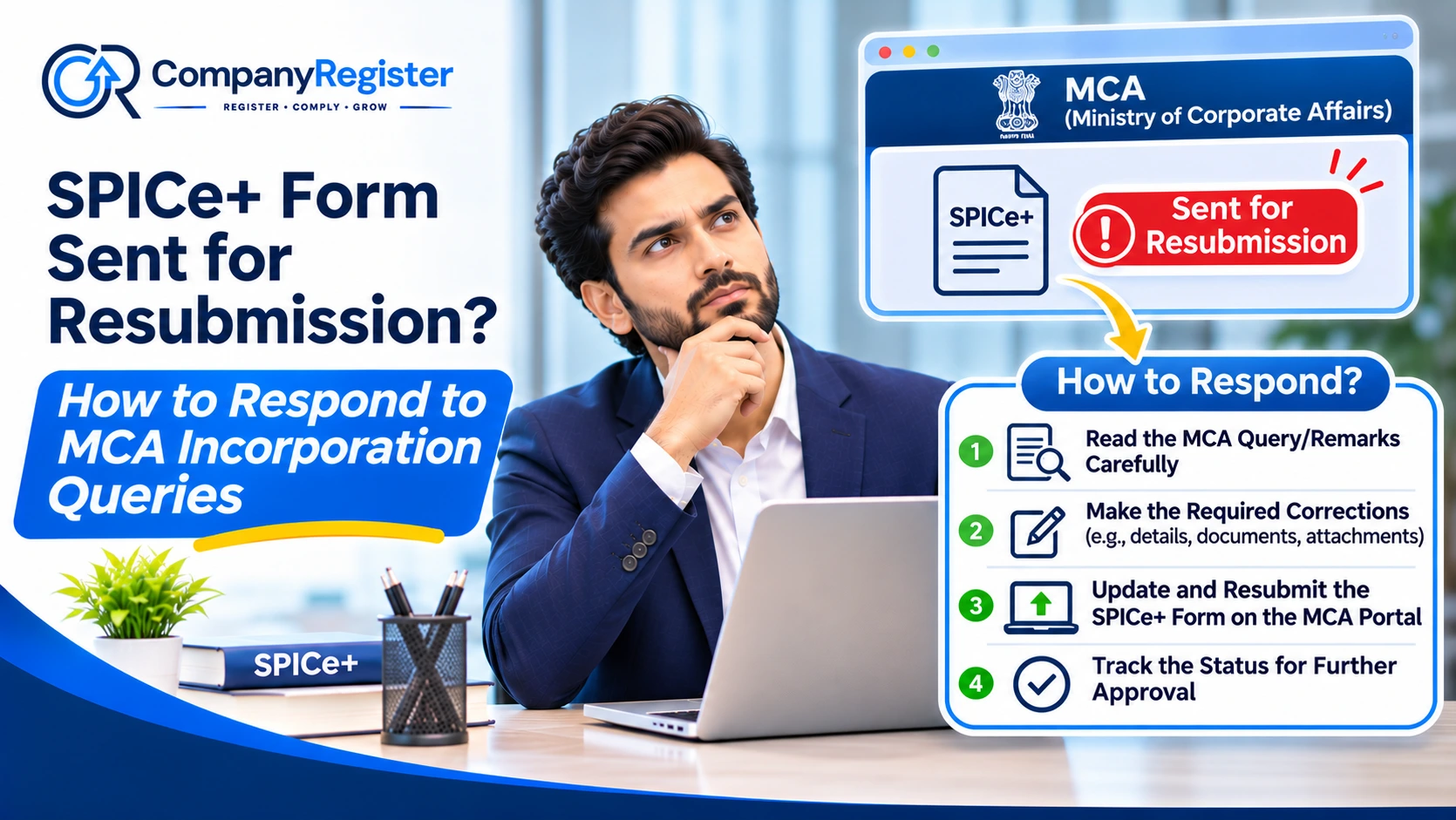
SPICe+ Form Sent for Resubmission? How to Respond to MCA Incorporation Queries
Respond to MCA incorporation remarks with a document checklist, MCA21 steps, a cost breakdown, deadline guidance and post-incorporation duties.
 20 Nov 2026 - Licenses
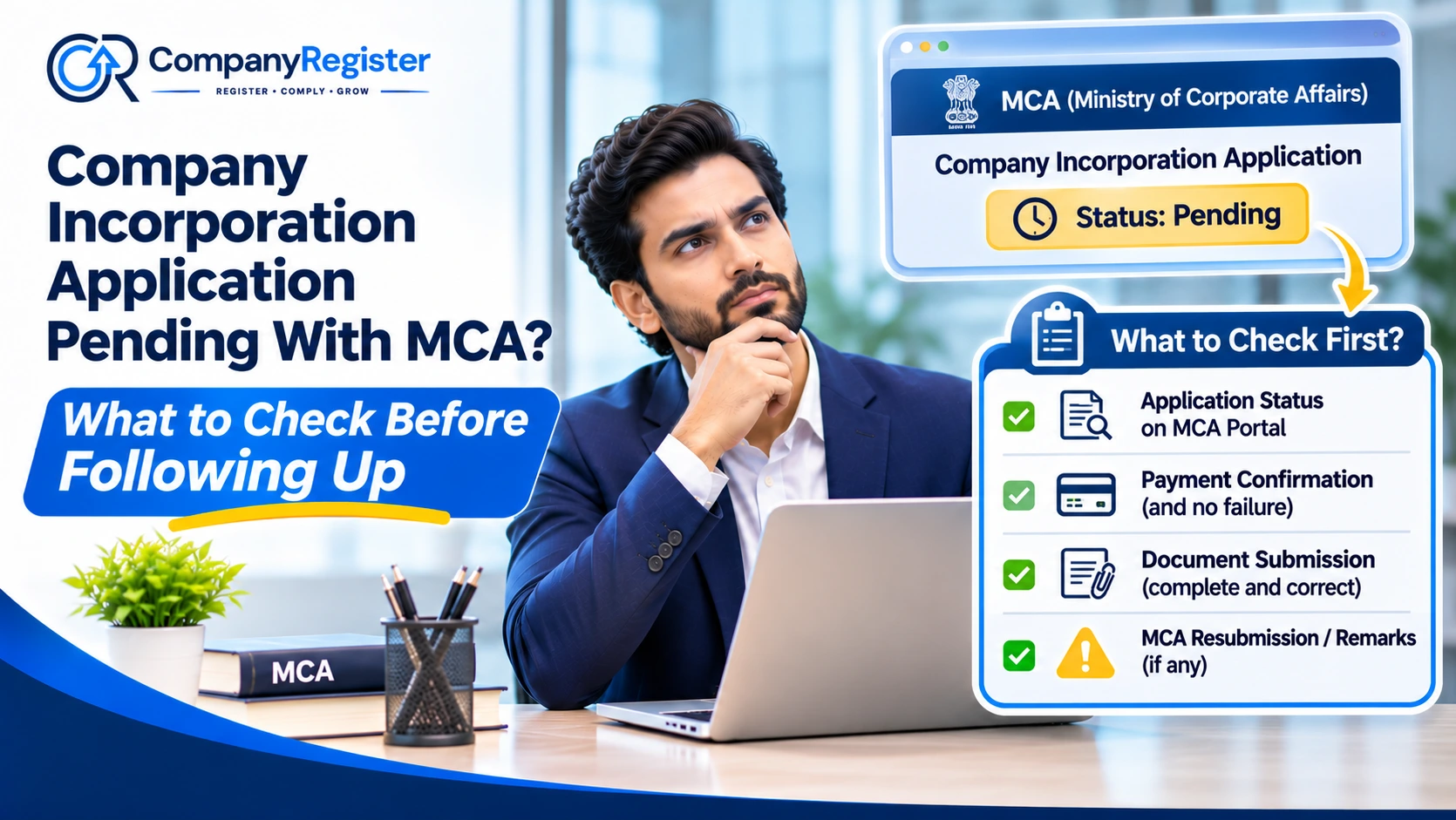
Company Incorporation Application Pending With MCA? What to Check Before Following Up
Check your MCA incorporation status, SRN and payment before following up. Understand SPICe+ documents, costs, processing stages and next steps.
 20 Nov 2026 - Licenses
Already a Director in Another Company? Can You Become a Director in a New Company?
See Section 165 limits, eligibility, DIN records, SPICe+ and DIR-12 steps, costs and continuing duties before taking another directorship.