
PAN and Aadhaar Details Do Not Match? How Can This Affect Company Registration?
19 Nov 2026 - Registrations
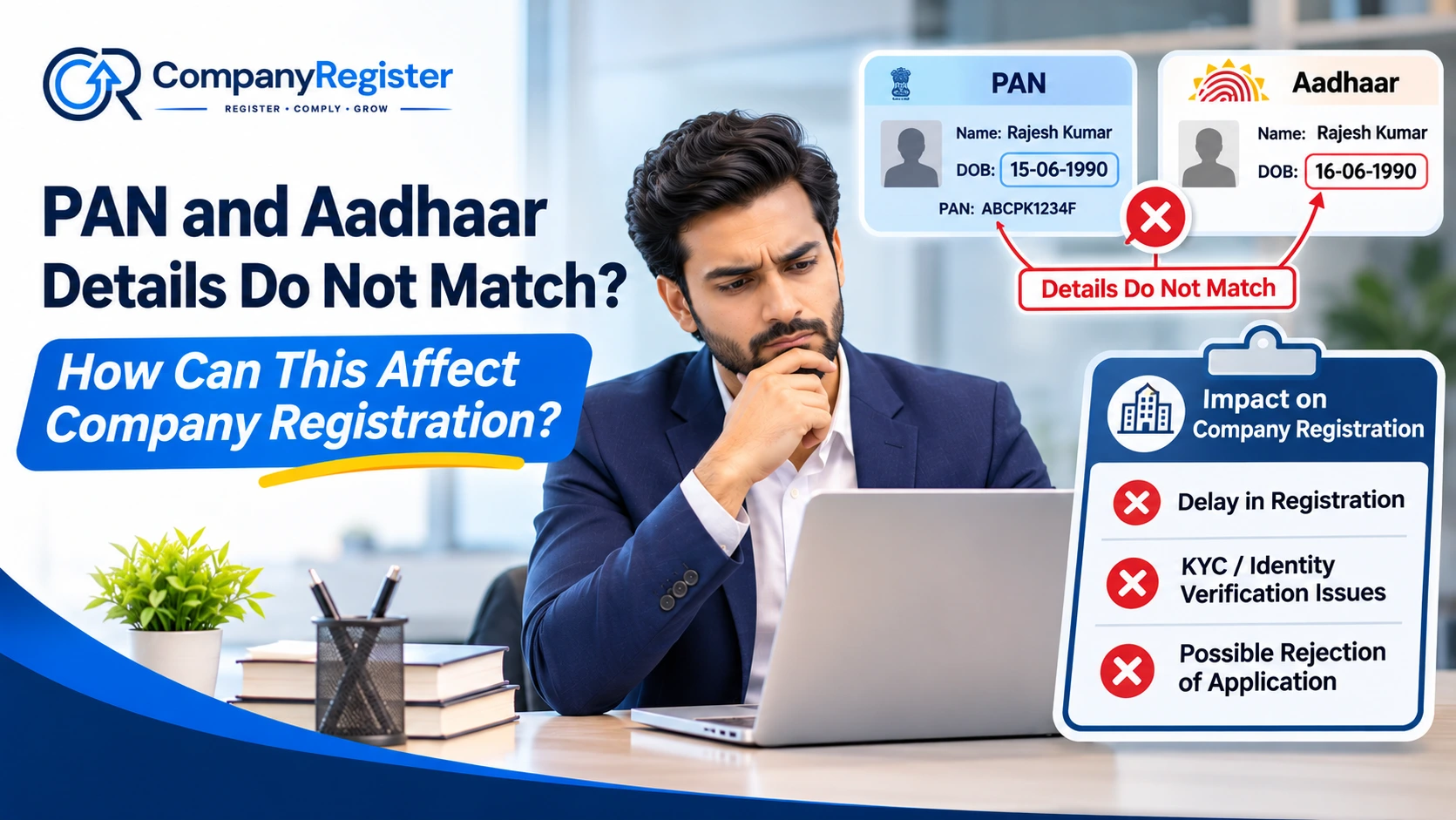
A PAN Aadhaar mismatch can delay company registration if the identity details needed for a director, digital signature or application cannot be validated. It does not automatically mean that incorporation is forbidden: first identify which record is wrong and which system has raised the issue, then correct the relevant record or application.
For a founder, the difficult part is often knowing where to begin. The Income Tax Department, the Aadhaar system, the digital signature provider and the Ministry of Corporate Affairs (MCA) serve different purposes; a successful check in one system does not guarantee that every other check will pass.
This guide separates preparation, submission and the response to an MCA observation. It focuses on Indian founders incorporating a company; requirements for foreign nationals or overseas documents may differ.
1. PAN Aadhaar mismatch company registration: who can proceed?
1.1 Identify the records involved
A difference between two identity records is a data problem, not a separate category of company or a stand-alone incorporation process. You can prepare an application if the proposed company and its participants meet the applicable legal requirements, but an unresolved difference can interrupt a particular verification or document review.
PAN–Aadhaar linking belongs to the income-tax system. A company incorporation application goes to MCA through SPICe+. A Digital Signature Certificate, or DSC, is issued through a certifying authority and used for electronic signing. These are connected in practice because they rely on personal identity details, but they are not the same approval.
Aadhaar is not a universal attachment for every incorporation merely because a founder has one. Whether it is needed for a particular identity update, authentication or linked service depends on that service and the applicant's circumstances. Conversely, a person who is required to link PAN and Aadhaar under income-tax rules should deal with that obligation separately; a company filing does not itself settle it.
1.2 Check the proposed director's position
Role: Identify each person who will be a first director, subscriber or both. The same individual may appear in more than one capacity.
Existing DIN: Ask whether a proposed director already has a Director Identification Number. An individual should not obtain a second DIN simply to join another company.
Identity facts: Establish the correct legal name and date of birth using reliable underlying records, rather than choosing whichever spelling is most convenient for filing.
Signing readiness: Identify who must sign electronically and whether their existing DSC is available and usable for the proposed filing.
Company structure: Confirm that the intended type of company and its proposed participants satisfy the applicable Companies Act requirements.
For example, Section 149 of the Companies Act 2013 sets minimum director requirements according to the type of company. An identity discrepancy does not remove those requirements, and a founder should not substitute another person's identity to get past a validation screen.
These checks are particularly useful where a director has been involved in another company. An existing DIN creates a record that must be taken into account; an applicant with no DIN may instead seek one through the incorporation route where the form permits it.
2. Documents to assemble and what each one does
Prepare a separate file for each individual and a second file for the proposed company. Keep readable copies and the underlying originals accessible. The exact attachment set depends on the form, the person's status and the facts of the application; the current SPICe+ instructions on MCA21 determine what must be attached in the relevant case.
2.1 Personal identity and signing records
PAN details: Keep the PAN and the person's name and date of birth as recorded for PAN. PAN is central to the identity information of an Indian individual in the incorporation application.
Aadhaar details, where relevant: Keep access to the Aadhaar record if it is needed for a correction, linking request or applicable authentication. Do not assume that an Aadhaar copy must be uploaded to every MCA filing.
Residential address proof: Prepare the applicable proof for the individual in the format and form required by MCA. Its purpose is to support the residential address, which is separate from the company's registered-office address.
Existing DIN information: Record the DIN and corresponding director details if the person already has one. This identifies the existing MCA director record.
DSC and access details: The required signatory needs access to a valid DSC and the means to use it. The certificate supports electronic signing; it is not a substitute for a PAN or DIN.
Evidence for an identity correction: If an issuing authority requires supporting proof for the particular change, assemble the evidence it accepts for the name, date of birth or other field being amended.
A company registration KYC mismatch may involve information rather than a missing scan. Keep a simple field sheet showing the person's full name, date of birth, PAN, DIN if any, residential address, email and mobile number. It gives the people preparing the forms one reference point and makes it easier to see which detail belongs to which individual.
2.2 Company incorporation records
The incorporation pack also includes the proposed company's constitutional information, subscriber details and registered-office particulars. Depending on the application, MCA's SPICe+ workflow uses linked forms such as the electronic memorandum and articles, and declarations by subscribers and first directors.
Evidence for the registered office has a different purpose from a director's residential proof: it supports the company's proposed office. Assemble the applicable office evidence and permissions under the form instructions rather than treating a founder's personal Aadhaar address as automatic proof of the company's office.
If a professional is preparing the application, provide a clear, legible set through an agreed secure channel. Ask who will retain the final signed versions and acknowledgements. Avoid circulating identity documents in a large group chat; access should be limited to people who need them for the filing or correction.
3. How to correct the details and file the company application
For someone asking what the procedure to register a company is, the order matters. Settle the identity issue at the source where possible, make the signatories ready, and then submit the incorporation application. The steps below separate work done before filing from what happens after submission.
Prepare a record-by-record comparison. Put the PAN, Aadhaar, any existing DIN record and intended application details alongside one another. Mark the specific field that differs and identify the record that should be corrected.
Use the relevant correction channel. For a PAN correction, use the PAN correction services available through the authorised PAN service providers. For an Aadhaar correction, use the available UIDAI update channel for the particular field; some updates may require a visit to an Aadhaar centre. Keep the acknowledgement.
Deal separately with PAN–Aadhaar linking, if applicable. The Income Tax Department's e-filing portal provides the relevant linking and status services. Complete any applicable correction or payment requirements through the prescribed channel rather than assuming that updating one record automatically completes linking.
Resolve existing director and signing records. Where the person has a DIN, use the existing number and address any change to that record through the applicable MCA process. Arrange a DSC for each required signatory and complete the relevant MCA user and DSC registration steps.
Start the MCA incorporation application. On MCA21, use SPICe+ Part A for the proposed company name and Part B for incorporation particulars. Follow the workflow for linked forms and attachments applicable to the company. The integrated application also provides for DIN allotment for eligible proposed first directors who do not already have one.
Review, sign and submit. Check the completed application and linked forms, attach the applicable documents, obtain the required electronic signatures and complete payment through MCA21. Save the service request number and payment acknowledgement.
Track the submitted filing. Use the MCA service request status and communications to see whether the application is being processed, requires action or has been decided. If an observation is issued, act on its wording and the deadline shown in the applicable communication.
3.1 Preparation and source-record correction
The correction route depends on where the error sits. If PAN has the correct name and Aadhaar has an incorrect name, the necessary update is on the Aadhaar side; if the reverse is true, it is a PAN correction. When neither record reflects the correct underlying details, identify the supporting evidence before starting either request.
Do not plan a filing around the date on which a correction request is submitted. A request acknowledgement shows that a request was made; it does not by itself show that the changed detail is available for a later validation. Retain the updated record or status result as part of the preparation file.
A founder with an existing DIN has an additional dependency: the MCA director record may need to reflect an authorised change in particulars. The applicable MCA form and supporting requirements depend on what has changed. Treat this as a separate record-update task, not as a reason to apply for another DIN.
3.2 Submission and status tracking
SPICe+ is an integrated incorporation workflow, not merely a name reservation. Part A addresses the proposed name; Part B carries the incorporation application and related particulars. The applicable linked forms must agree with the final application, including the roles in which individuals appear.
Before signing, allocate a final review to someone other than the person who entered the data, if another reviewer is available. That review should cover the complete application, not only the PAN field. Once submitted, retain the service request number so that the person responsible for the filing can follow its status and respond to an MCA communication.
A founder who wants assistance with the wider filing can use Private Limited Company Registration services. Give the service provider the existing record status and any pending correction acknowledgement at the outset, so its scope can account for the identity issue.
4. Government charges and professional costs
There is no single reliable figure for a mismatch case. The amount depends on which record needs correction, the company filing particulars and whether the founder engages a professional. Ask for a written breakdown before authorising work, with government payments separated from service charges.
Cost item | Who may charge it | Question to ask |
|---|---|---|
PAN correction | Applicable PAN service channel | What does the current correction service charge for this application? |
Aadhaar update | Applicable UIDAI update channel | Does the selected update attract a charge, and is a centre visit needed? |
PAN–Aadhaar linking, if applicable | Income-tax system | Is a payment required for this person's linking request? |
DSC | Certifying authority or its service provider | Does the quote cover issuance, any required device and assistance? |
MCA filing and applicable stamp duty | Government through the filing process | What does MCA calculate for the proposed company and its filing particulars? |
Professional work | Engaged professional or service provider | Does the quote include identity correction, linked forms and a response to an MCA observation? |
A low incorporation quote may cover preparation of the application but exclude correction work for a director's existing records. It may also exclude a replacement DSC or work on a new application if an earlier filing is finally rejected. Those exclusions are not necessarily improper; they matter because they change the total cost and who is responsible for each task.
Keep receipts and distinguish an official payment from an amount collected by an intermediary for its services. If a filing requires fresh action, ask for the applicable charges for that specific action instead of assuming that the earlier payment will cover it.
5. How long should you allow?
There is no verified universal turnaround in the supplied sources for a PAN–Aadhaar mismatch followed by incorporation. A usable schedule should therefore be built around milestones, not a promised number of days.
Identity update: The time starts with collecting acceptable evidence and includes review by the relevant issuing authority. A request for additional evidence or an update that requires an in-person visit can add time. If both PAN and Aadhaar need changes, the founder may have more than one independent request to follow.
Signing and director records: Allow separately for obtaining or using a DSC and, where applicable, updating an existing MCA director record. A corrected identity record may affect what the DSC provider or MCA needs to see; these tasks should not be assumed to finish automatically when the first correction is requested.
MCA processing: The filing moves through submission, scrutiny and a decision. The duration depends on the completeness of the application, the applicable workload and whether MCA asks for further action. A resubmission adds a founder-controlled correction period as well as further processing time.
For planning, record the date and acknowledgement for each request and assign one person to monitor it. If the incorporation supports a lease, funding transaction or customer contract, avoid committing to an incorporation date that depends on an unfinished identity correction. The certificate of incorporation, rather than a submitted application, is the meaningful completion milestone.
6. Common identity errors and how to respond
6.1 Field errors and source-record errors
Spelling or name order differs: Compare the complete name rather than only the surname. A typing error in the draft application calls for a form correction; an incorrect name on an issued identity record calls for the relevant record-correction route.
Date of birth differs: Do not pick a date merely because one portal accepts it. Identify the correct date from the underlying evidence, then correct the record that contains the error.
Existing DIN details differ from PAN: The filing may involve an older director record as well as a current PAN record. Find which particulars need updating before relying on the existing DIN in a new application.
DSC identity differs from the proposed signing details: A digital signature has its own identity information. Ask the issuing provider about the applicable update or replacement route; do not assume a PAN correction automatically changes an existing certificate.
Information is entered in the wrong person's field: Where several founders are both directors and subscribers, a transposed PAN or date of birth can create an apparent mismatch even though each person's documents are correct. Compare each field with the role and individual it belongs to.
Attachment cannot support the information: A cropped, unreadable or incomplete file can make review difficult even when the details themselves are correct. Replace it with a legible document that meets the relevant form instructions.
A PAN Aadhaar name mismatch during incorporation should not be diagnosed from a generic error message alone. For example, an MCA PAN name mismatch and a PAN–Aadhaar linking mismatch point to different checks. Capture the exact message and the stage at which it appeared before deciding what to change.
6.2 Filing status and correction
If MCA marks an application for resubmission, read every observation and identify the affected fields, attachments and linked forms. Make the requested corrections through the applicable MCA workflow, obtain signatures again where required, and submit within the deadline stated in the communication. Keep the revised acknowledgement alongside the original filing record.
Resubmission and rejection are different outcomes. An opportunity to resubmit means the applicant has been asked to address defects in the existing filing; a final rejection is a decision on that application. The appropriate next filing and any payment depend on the decision and current MCA procedure, so do not assume that uploading a corrected document alone will reopen a rejected application.
One less obvious source of delay is correcting only the attachment named in an observation while leaving an inconsistent value elsewhere in the application. Review the affected linked forms as part of the response, but avoid making unrelated changes without understanding their effect on the filing.
7. What to do after the company is incorporated
The certificate of incorporation is the starting point for the company's own records. Save the certificate and final incorporation documents, and check the company name, registered-office particulars and director information against the approved filing. Keep the company's identity separate from each founder's personal PAN and Aadhaar records.
For a company having share capital, Section 10A of the Companies Act 2013 requires the prescribed declaration before it commences business or exercises borrowing powers. The declaration is filed within 180 days of incorporation and concerns the subscribers' payment for their shares. Organise the subscription payments and evidence promptly rather than leaving the work until the deadline.
Section 139(6) generally requires the board of a company other than a government company to appoint its first auditor within 30 days of registration; the provision also addresses what happens if the board does not do so. Assign responsibility for that appointment as part of the first board-level compliance plan.
Directors should also maintain their MCA particulars and complete applicable director KYC requirements. The company's ongoing obligations depend on its facts and activities, so create a calendar for relevant filings and retain access to the email addresses and credentials used for statutory communications.
8. Choose your next three actions
If the application is still a draft: Assign one person to compare each founder's identity records and identify any field that needs a source-record correction.
If a correction is already pending: Track its acknowledgement, assemble the remaining incorporation pack and avoid scheduling submission around an unconfirmed update.
If MCA has issued an observation: Give the complete remark, filing status and deadline to the person handling the response; use specialist help where an existing DIN, DSC or disputed identity record makes the correction path unclear.
Begin the process online via the official government portal, or engage Company Register for end-to-end assistance
Need personalised advice for your business?
Share your query and our compliance team will connect with you shortly.
Frequently Asked Questions
Does a PAN–Aadhaar mismatch automatically prevent company incorporation?
Should I correct PAN or Aadhaar first?
Is Aadhaar compulsory for every company incorporation?
Does a director who already has a DIN need another one for a new company?
Will correcting PAN automatically update an existing digital signature certificate?
What should I do if my SPICe+ application is marked for resubmission?
How much does it cost to correct the mismatch and register a company?
How long does correction and incorporation take?
Recent Blogs
 20 Nov 2026 - Licenses
SPICe+ Form Sent for Resubmission? How to Respond to MCA Incorporation Queries
Respond to MCA incorporation remarks with a document checklist, MCA21 steps, a cost breakdown, deadline guidance and post-incorporation duties.
 20 Nov 2026 - Licenses
Company Incorporation Application Pending With MCA? What to Check Before Following Up
Check your MCA incorporation status, SRN and payment before following up. Understand SPICe+ documents, costs, processing stages and next steps.
 20 Nov 2026 - Licenses
Company Name Approved but Incorporation Not Filed? What Happens If the Name Reservation Expires?
Learn when a reserved company name lapses, whether to extend or reapply, and what to prepare for SPICe+ filing, fees and incorporation.