
No NOC for Your Registered Office? What Can You Do Before Registering a Company?
19 Nov 2026 - Registrations
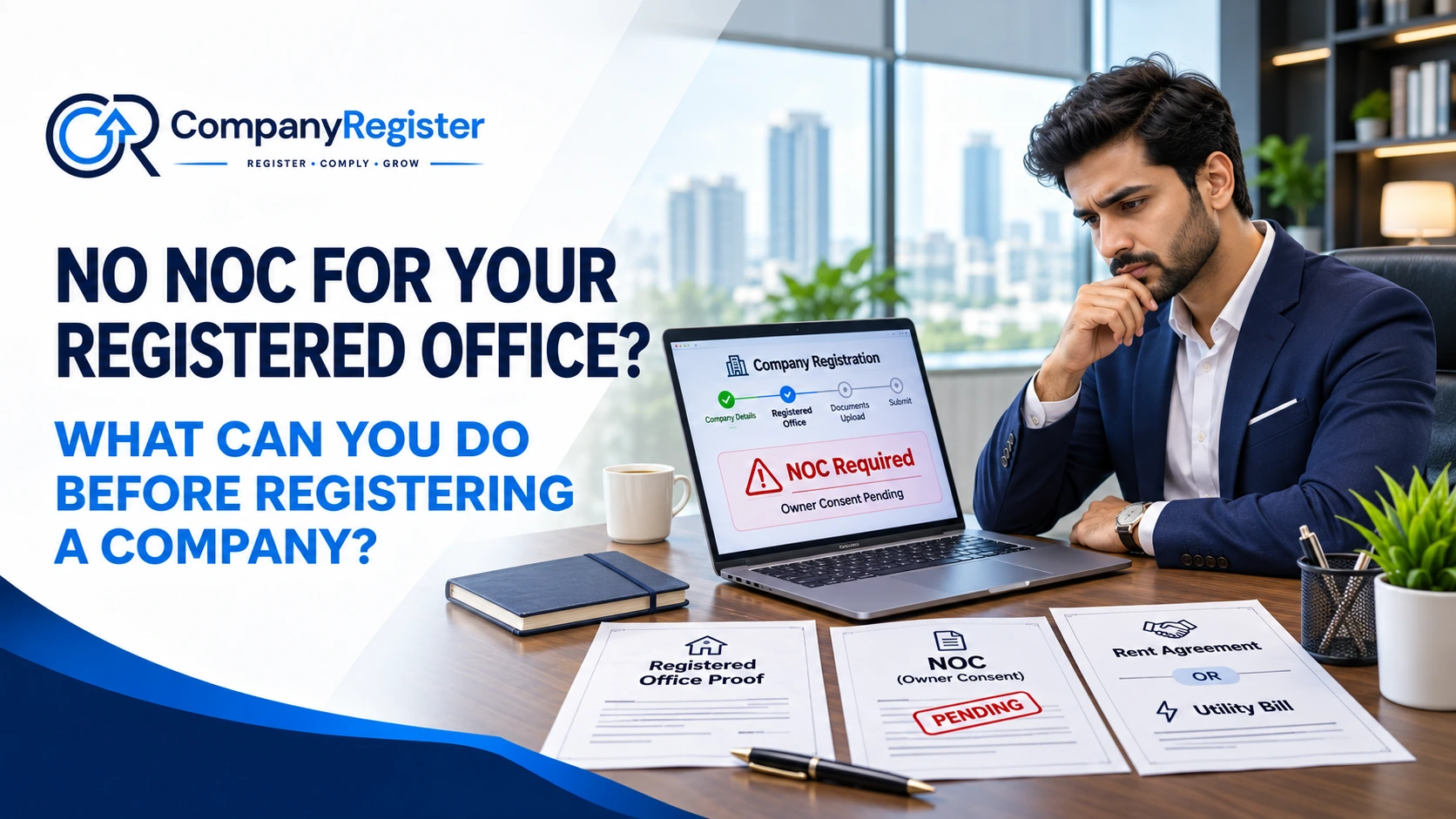
Company registration without NOC may be possible if you have another valid basis to use the premises, or if you provide an address for correspondence at incorporation and establish the registered office within the statutory period. A missing document is not permission to use someone else’s property: the company must be able to support its right to use the address it eventually registers.
If your landlord will not sign, you can consider a property you own, another owner’s premises with consent, or a workspace that can genuinely provide registered-office use. The right choice depends on who controls the property, what evidence is available and whether the address can receive official communications.
1. Can you complete company registration without NOC?
1.1 What the address must do
Under Section 12 of the Companies Act, 2013, a company must have a registered office within 30 days of incorporation. That office must be capable of receiving and acknowledging communications and notices. It is the company’s formal contact point, even if founders work elsewhere or run the business online.
An NOC is a written statement that the person giving it has no objection to the proposed use. It is useful evidence of consent, but the relevant MCA filing also considers other evidence, such as a lease or proof of ownership, depending on the arrangement. Do not assume either that every property needs an identically titled NOC or that the absence of an NOC removes the need for permission.
Section 7 of the Act also recognises an address for correspondence until the registered office is established. This distinction gives some founders time to arrange their permanent documentation; it does not remove the Section 12 obligation. The Ministry of Corporate Affairs’ MCA21 portal is the official filing channel.
1.2 Pre-filing eligibility checks
The private limited company registered office requirements focus on the company’s ability to use and maintain an identifiable address. Before choosing one, assess these conditions:
The address is a real, identifiable place where company communications can be received and acknowledged.
The company has, or can obtain, a genuine right to use it as its registered office.
The person offering permission has authority to do so; an intermediary’s willingness alone does not establish that authority.
The proposed arrangement can continue after incorporation, including access to notices and statutory records where applicable.
The premises arrangement permits the proposed use; residential, building or contractual restrictions may be relevant to the particular property.
Company registration without owner permission is not a safe workaround simply because a founder already lives or works at the address. A company is a separate legal person, and use of another person’s premises must rest on an arrangement that permits the company’s use.
Also consider who will open or forward mail when a founder is travelling. A registered office can fulfil its legal purpose only if the company has a reliable way to act on communications received there. This is an operational decision as well as a filing decision.
2. Which address can you use when the NOC is unavailable?
2.1 Compare the available premises
When a registered office NOC is not available, start by identifying a place over which the company can obtain a clear right of use. Ownership is not the only possible arrangement. The comparison below focuses on control and dependency rather than on the lowest headline price.
Option | When it can work | Decision point |
|---|---|---|
Founder-owned home | The owner permits the company to use the address and the premises are suitable for receiving communications. | Consider privacy and whether the company may need a different address later. |
Family member’s or friend’s property | The person with authority agrees to the company’s use and can support the arrangement. | The company relies on that person for continued access and cooperation. |
Rented premises | The company has a suitable arrangement with the person entitled to grant use. | Read the terms for registered-office use, duration and termination. |
Shared or coworking premises | The provider offers registered-office use and has authority to grant it. | Ask what happens to mail and the address if the plan ends. |
Company registration using a home address can be sensible for a founder who does not yet need a separate office. If the home is owned by someone else, however, living there does not by itself establish the company’s right to use it. If the founder owns it, the company should still be able to demonstrate the basis on which it uses the property.
A shared desk and a registered-office arrangement are different purchases. Before paying a provider, establish whether its plan allows the company to use the particular address as its registered office, how notices are handled and whether the arrangement can be renewed. A cheap introductory plan may be less attractive if it expires before the company is ready to move.
A later move can involve a separate filing and administrative work. Depending on the move, approvals or additional requirements may also apply. Weigh that switching cost against the immediate cost of choosing a more stable address.
2.2 Use a correspondence address while you arrange an office
The company registration correspondence address is a contact address for the period before the registered office is established. It can be useful when a founder can receive communications now but needs more time to secure a suitable registered office. It should be an address at which the applicant can actually receive correspondence, not an invented or borrowed address used without permission.
This route is a timing option, not a company registration NOC alternative that cures a lack of authority at the eventual office. Plan the registered-office arrangement before filing: the 30-day statutory period runs from incorporation, not from the day the founder begins searching for premises. The applicable MCA form and attachments must be completed for the address selected.
For example, a founder may have a dependable correspondence address but be negotiating a longer-term workspace agreement. The founder can assess the correspondence-address route while arranging the office, provided the company can establish and verify its registered office within the required period. The negotiation should not be treated as evidence that the company already has the right to use the workspace.
3. What registered office documents should you prepare?
3.1 Evidence of premises and permission
The company registration registered office documents should explain three separate things: the location, the basis on which the company may occupy or use it, and the authority of the person granting that use. The exact set depends on the premises and the current form instructions.
Document or evidence | Purpose and preparation |
|---|---|
Address evidence, such as a utility bill | Connects the stated address to the premises. MCA form instructions call for specified utility-bill evidence, subject to the age and other conditions stated in the applicable form. |
Ownership evidence, where applicable | Shows the basis of an ownership claim. The relevant property record should identify the premises and the person claiming ownership. |
Lease, rent or licence arrangement, where applicable | Sets out the basis and terms of use when the company does not own the premises. Keep the signed arrangement and any other evidence required by the form. |
Permission or authorisation, where applicable | Shows that the company may use the premises as its registered office. It should identify the premises, the company or proposed company, the permitted use and the person granting permission. |
Authority of a representative, where relevant | Supports permission given by someone acting for an owner or another entity. The evidence depends on the arrangement and the representative’s authority. |
For registered office address proof in India, an address on a bill and a right to occupy are different facts. A bill can help identify a place; it does not, by itself, grant the company permission to use it. Equally, a signed permission should be supported by an understanding of why the signatory is entitled to grant it.
A NOC for a company registered office can be a straightforward written consent rather than a complicated contract. Its usefulness comes from the substance: who is consenting, which premises are involved and whether use as the company’s registered office is allowed. Do not assume that a particular label replaces the other evidence required by the filing.
For SPICe Plus registered office proof, prepare clear, legible electronic copies in the formats accepted by the current MCA filing system. If the registered office is being supplied after incorporation, the applicable INC-22 attachment requirements matter instead. Keep the signed originals and underlying records available to the company.
3.2 Other incorporation documents
The address package is only one part of a company incorporation application. Applicants also need the identity, address and other particulars of the proposed subscribers and directors, together with the company’s proposed name, business objects and constitutional documents as applicable. The precise attachments and declarations depend on the proposed company and the current MCA forms.
Collect these materials in parallel with the premises papers so that the office issue does not conceal another incomplete part of the application. A founder using an adviser can ask for a single document list identifying who must provide each item and who will sign or certify the relevant forms.
4. How do you file the incorporation application?
4.1 Prepare, submit and follow up
The sequence below is designed for a first-time founder incorporating a private limited company. It separates the decision about the office from the electronic incorporation filing and from the action needed after the Registrar responds.
Choose the address route. Decide whether the registered office is ready to be supplied with incorporation or whether an address for correspondence will be used while the office is established. Assign someone responsibility for receiving communications at the address provided.
Prepare the company particulars. Agree on the proposed name, business objects, subscribers, directors and share structure. Arrange the required digital signatures and professional certification for the forms that require them.
Start SPICe+ on MCA21. Use SPICe+ Part A for the name reservation component and Part B for incorporation particulars, following the portal’s current workflow. Name and incorporation submissions can be handled through the available integrated process.
Complete the linked filings that apply. The incorporation workflow includes linked forms such as AGILE-PRO-S and, where applicable, electronic memorandum and articles forms. Complete the declarations and attachments required for the particular company rather than assuming every linked form applies in the same way.
Submit and pay through the portal. Review the final forms, arrange the necessary signatures and certification, submit the application and retain the service request details and payment record. These records help the applicant track the submission.
Monitor the response. Follow the MCA application status and respond to any resubmission request within the period specified in that communication. If the application is approved, retain the certificate of incorporation and the filed records.
Complete the office filing if it remains outstanding. Where the registered office was not established and verified through the incorporation filing, use the applicable INC-22 process on MCA21 to notify and verify it within the statutory period. Do not treat a correspondence address as the completed registered-office filing.
The MCA’s current form instructions govern the details of the filing and its attachments. The portal workflow can change, so use the live form and its instructions for the application being submitted. Company Register’s Private Limited Company Registration service is an option for founders who want assistance coordinating the incorporation work.
5. What should you budget, and how long can it take?
5.1 Government charges and other costs
There is no single reliable fee for every incorporation. The amount depends on the proposed company’s particulars, applicable filing charges and stamp duty, among other factors. Use the MCA portal’s applicable fee calculation and the relevant state stamp-duty information for the actual filing rather than relying on a generic package price.
Cost category | What to ask or budget for |
|---|---|
Government filing charges | Identify the charges shown for the applicable incorporation and any later filing. Keep the portal receipt separately from an adviser’s invoice. |
Stamp duty | Check the amount applicable to the company’s documents and state. It is separate from a professional’s service charge. |
Professional and digital-signature costs | Ask which preparation, certification, digital signature and follow-up services are included, and which are billed separately. |
Premises costs | Consider rent or licence charges, deposits, renewals and mail handling. Ask whether registered-office use is included in the quoted plan. |
Later changes | Allow for the work and applicable charges involved if a temporary address must be replaced. |
Request an itemised quote before engaging a provider. In particular, ask whether responding to an MCA resubmission, preparing a separate office filing and changing the address later are included. Those are different pieces of work and may not be covered by an incorporation-only price.
5.2 Milestones that affect the schedule
The founder controls some of the timeline: agreeing on the premises, collecting signatures and completing the application. The Registrar’s review and any request for changes introduce further variability. A name issue or an unresolved question about who can authorise the address can add time before or after submission.
Do not build a business launch around an unverified approval estimate. Instead, track three milestones: when the application is ready to submit, when the Registrar decides it, and, if needed, when the registered office is established and verified. The last milestone has a statutory deadline even if the company receives its incorporation certificate earlier.
If the address arrangement is temporary, also note its end date. Having a valid address on the filing date is useful only if the company has a plan for receiving communications until any move is completed.
6. Which mistakes can hold up the filing?
Premises-related problems are often fixable, but the correction must address the underlying fact. A cleaner scan cannot turn an unauthorised arrangement into an authorised one.
Confusing the contact person with the person who can grant use. A workspace salesperson or tenant may be helpful without having authority to permit registered-office use. Obtain evidence from the appropriate person or establish the representative’s authority.
Using inconsistent address details. Differences in a unit number, building name or street description can make it unclear whether the papers concern the same premises. Reconcile the records and explain a genuine difference where needed.
Treating an address bill as consent. An address record and permission serve different purposes. Supply the applicable evidence for each rather than expecting one document to establish both.
Assuming a rental arrangement covers every use. For company incorporation without landlord NOC, read the actual agreement and identify the basis on which the company may use the address. If the right is unclear, obtain appropriate permission or choose another place.
Submitting incomplete or unsuitable copies. Missing pages, illegible signatures or an attachment that does not meet the form’s conditions can make review difficult. Replace the deficient record with a complete, usable copy.
Ignoring a resubmission communication. A query is a request for action, not an approval. Read each point, make the requested correction where appropriate and respond through the prescribed process within the stated period.
Do not create a consent, signature or tenancy arrangement that does not exist. A filing should represent the company’s actual position; a faster submission is not worth making a false declaration.
For a company registration rented property NOC issue, the useful correction may be to secure registered office landlord consent, clarify the terms of an existing arrangement, or change the proposed premises. Which option works depends on who has authority and what the company can genuinely document.
7. What must the company do after incorporation?
7.1 Operate the registered office
Once established, the registered office remains the company’s formal point for receiving communications. Put someone in charge of collecting mail, recording when it arrives and passing it promptly to the person who can act. A provider’s promise to forward notices should be reflected in the company’s operating arrangement, not left as an informal expectation.
Section 12 also requires the company to display its name and registered-office address at its registered office and other places where it carries on business, in the manner prescribed. It also sets out particulars to be included on specified business communications and documents. Arrange the display and update company stationery and communications as applicable.
Keep the evidence supporting the office arrangement and the company’s incorporation records organised. If a licence is due for renewal, allocate responsibility before it expires. Directors should know who controls access to the premises and how official correspondence reaches them.
7.2 Plan for an address change
A registered office can change, but changing it is not merely a matter of updating a website. Section 12 requires notice of a change to the Registrar, and the applicable procedure depends on the nature of the move. Some moves can involve additional approvals or a different process, particularly where the change affects jurisdiction.
Before ending an old arrangement, plan the new one and the relevant filings. Preserve a way to receive communications during the transition and update business records once the change is effective. This reduces the risk of a notice being sent to an address the company no longer monitors.
8. Choose your next three actions
Identify the location you can control. If a founder owns a suitable property, assess that option first. If it belongs to a landlord, relative or workspace provider, establish who can permit the company’s use and whether the arrangement can last.
Decide whether the office is ready now. If it is, prepare the incorporation filing around that address. If it is not, assess the correspondence-address route and set a concrete plan for establishing the registered office within the statutory period.
Set the filing budget and responsibility. Separate official charges from professional and premises costs, then decide who will prepare the application, monitor the MCA response and handle any outstanding office filing.
Begin the process online via the official government portal, or engage Company Register for end-to-end assistance
Need personalised advice for your business?
Share your query and our compliance team will connect with you shortly.
Frequently Asked Questions
Can I register a company without a landlord's NOC?
Can a correspondence address replace a registered office permanently?
Can I use my home as the company's registered office?
Can a coworking provider authorise use of its address?
When is INC-22 relevant after incorporation?
Does a utility bill alone prove permission to use an address?
What costs should I expect beyond government filing charges?
What happens if the company changes its registered office later?
Recent Blogs
 20 Nov 2026 - Licenses
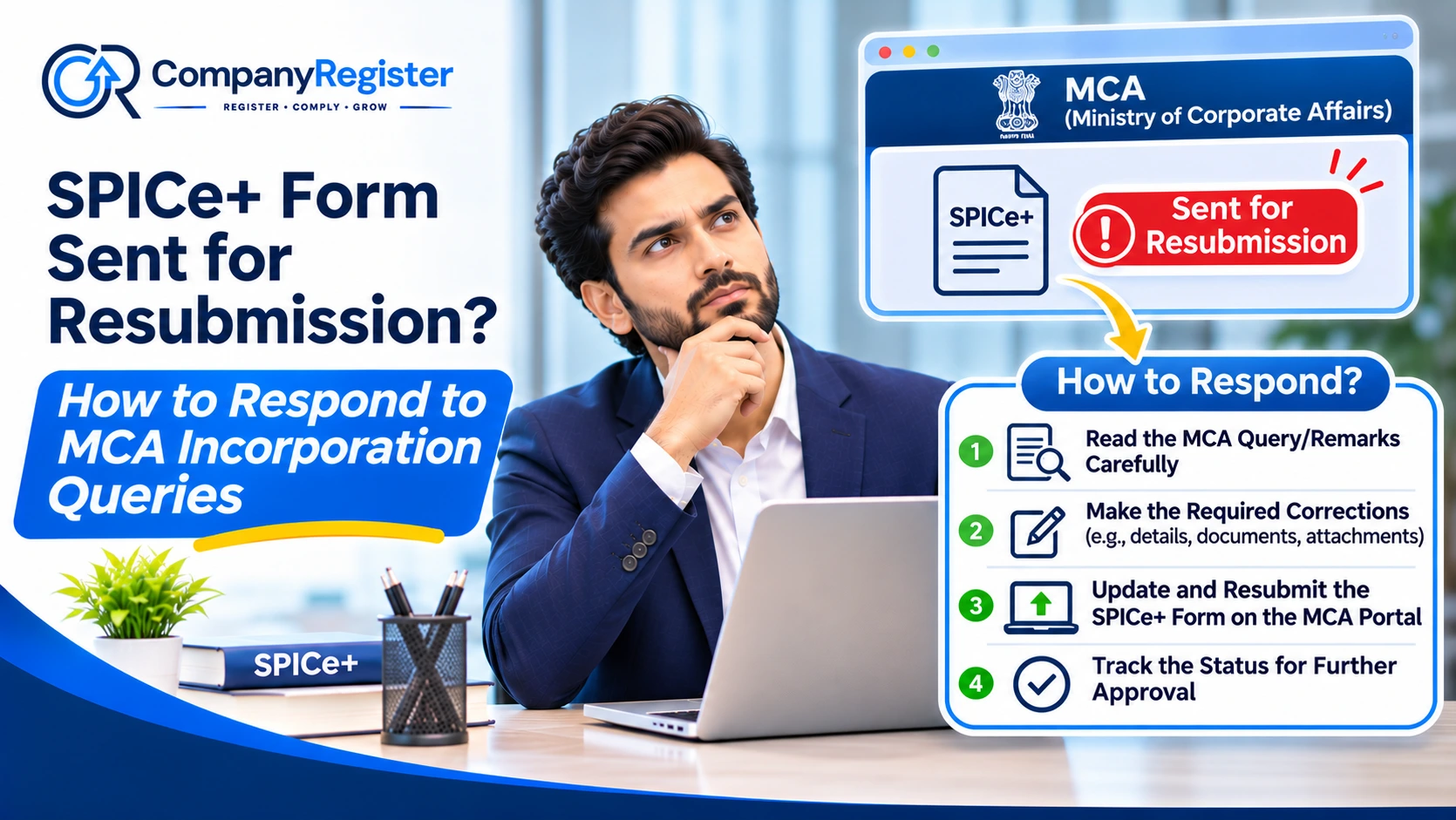
SPICe+ Form Sent for Resubmission? How to Respond to MCA Incorporation Queries
Respond to MCA incorporation remarks with a document checklist, MCA21 steps, a cost breakdown, deadline guidance and post-incorporation duties.
 20 Nov 2026 - Licenses
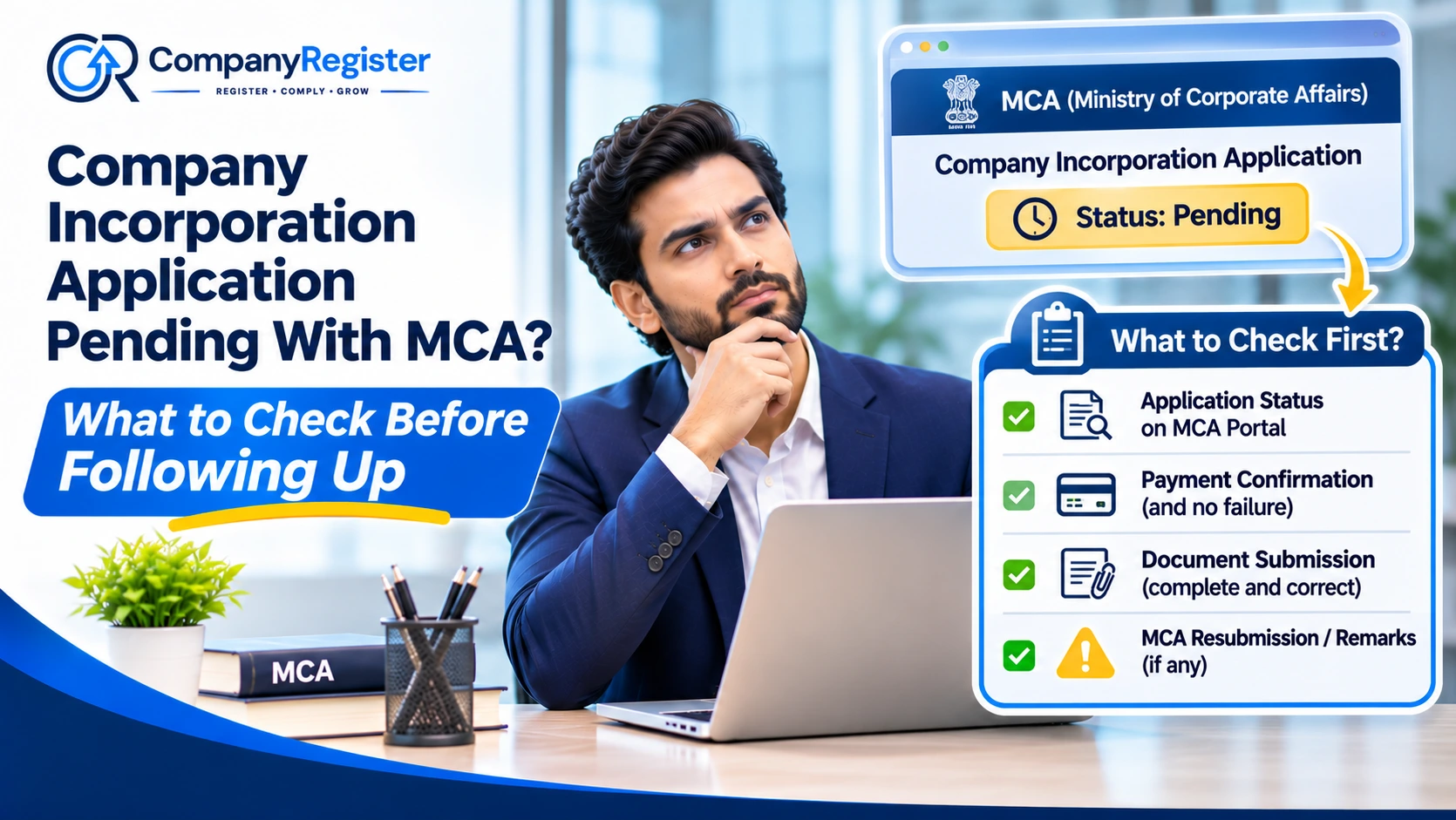
Company Incorporation Application Pending With MCA? What to Check Before Following Up
Check your MCA incorporation status, SRN and payment before following up. Understand SPICe+ documents, costs, processing stages and next steps.
 20 Nov 2026 - Licenses
Company Name Approved but Incorporation Not Filed? What Happens If the Name Reservation Expires?
Learn when a reserved company name lapses, whether to extend or reapply, and what to prepare for SPICe+ filing, fees and incorporation.